Day 3 of our Greek Adventure
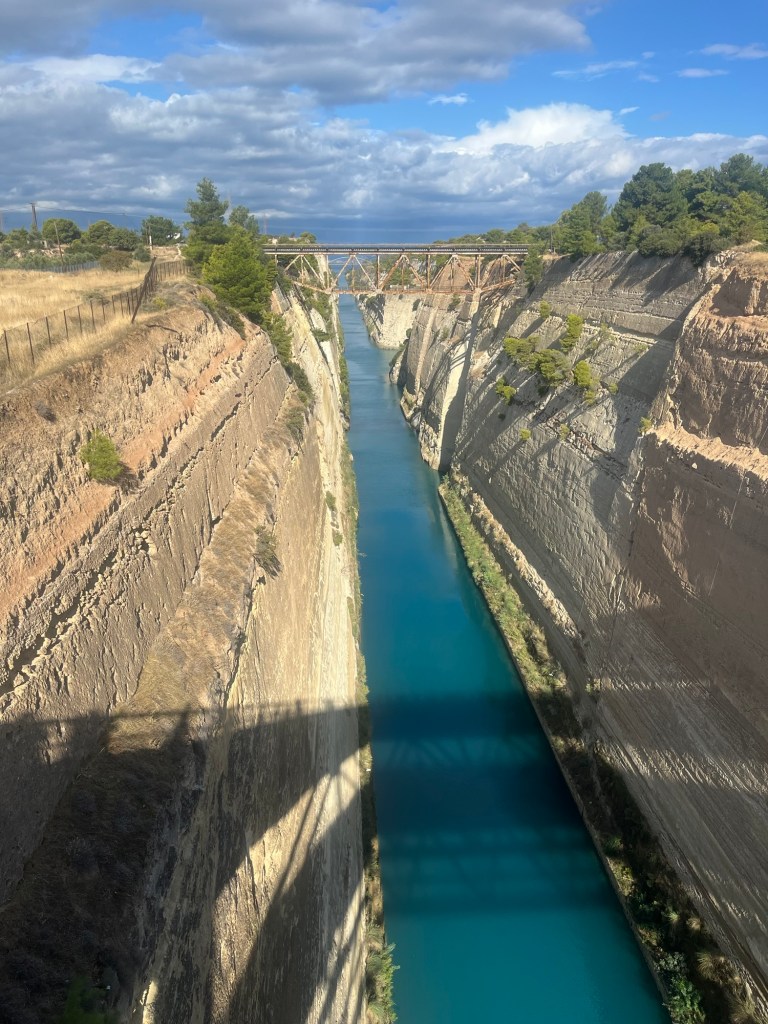
There are places in the world that stop you in your tracks, that make you catch your breath and wonder how on earth humans managed to create something so audacious. The Corinth Canal in Greece is exactly that kind of place—a jaw-dropping engineering marvel that literally carved a path between two seas.
A Narrow Passage with Big Dreams
Picture this: You’re standing on a bridge, peering down into what looks like a perfectly straight gash in the earth, nearly 4 miles long. The limestone walls plunge dramatically on either side, dropping about 300 feet to the shimmering blue ribbon of water below. And I do mean down—standing there, watching the aquamarine water catch the Mediterranean sun, I couldn’t help but feel my stomach do a little flip. It’s beautiful, yes, but that’s also a very long way to fall if you’re not careful with your selfie stick!
The canal connects the Gulf of Corinth with the Saronic Gulf, effectively turning the Peloponnese into an island and saving ships the 185-mile journey around the peninsula. The idea dates back to ancient times—Julius Caesar himself dreamed of this shortcut—but it wasn’t completed until 1893. Talk about a project with a long timeline!
Fascinating Facts That’ll Make You Go “Whoa”
Here are some nuggets of wonder about this incredible waterway:
It’s impossibly narrow. At just 70 feet wide at its base, the Corinth Canal is too narrow for most modern cargo ships. It’s like building a highway and then realizing SUVs are too wide for it! These days, it mainly sees tourist boats and smaller vessels, but watching them navigate through is absolutely mesmerizing.
The walls tell stories. Those towering limestone cliffs aren’t just rock—they’re layers of geological history, striped and sculpted by millennia. On a sunny day, they glow in shades of cream, rust, and gold. It’s like standing inside a very long, very narrow canyon that just happens to have ships floating through it.
Bungee jumping, anyone? For the truly adventurous (or possibly unhinged), there’s a bungee jumping operation here. Because apparently, some people look at that terrifying drop and think, “You know what? I should throw myself off that.” To each their own!
Ancient attempts failed spectacularly. The Roman emperor Nero actually started digging in 67 AD using 6,000 prisoners as laborers. He even ceremonially dug the first shovelful himself with a golden pickaxe. The project was abandoned after his death, leaving the dream unfulfilled for nearly two thousand more years.

The Delightful Chaos of Tourism
Here’s the thing about the Corinth Canal: it’s not a sprawling tourist complex with carefully managed crowd flow. It’s an intimate little slice of wonder, which means when you visit, you’re sharing the experience with dozens of other equally awestruck travelers. The viewing area isn’t huge, so you’ll find yourself doing that awkward tourist shuffle, trying to get the perfect photo while not photobombing someone else’s shot. But honestly? That’s part of its charm. The whole setup feels wonderfully unpretentious. Right next to the bridge, you’ll find small tents selling souvenirs—no massive gift shop complex, just local vendors offering their wares. It’s the kind of authentic, slightly chaotic travel experience that feels increasingly rare in our age of curated tourist attractions.
A Tradition Worth Keeping
During our visit, we browsed those modest souvenir stands and came away with treasures: postcards showing the canal from impossible angles, olive oil soaps that still make me think of Greek sunshine, an evil eye keychain for protection on future journeys, and—most importantly—a deck of playing cards.
You see, we have this tradition: we buy a deck of cards from every place we travel. It sounds simple, maybe even silly, but these cards have become our most precious souvenirs. Our collection has grown into a beautiful archive of adventures, and whenever we pull out the Corinth Canal deck for game night, we’re instantly transported back. We remember the vertiginous view, the aquamarine water far below, the press of excited tourists, the scent of those soaps we couldn’t resist, the bus rumbling nearby ready to whisk everyone to the next destination.
Those cards cost just a few euros, but they’re priceless. They keep the memories vivid and the wanderlust alive. Every shuffle reminds us why we travel: to stand at the edge of human ambition, to feel small and awed and thrilled, and to bring a little piece of that wonder home with us.
Why You Should Go
The Corinth Canal isn’t going to take up your entire day. It’s not a sprawling archaeological site where you’ll wander for hours. But it is a gem—a stunning, slightly dizzying, absolutely unforgettable gem that deserves a spot on your Greek itinerary.
Come for the breathtaking views. Stay for the wonder of human determination etched into stone. And maybe, just maybe, start your own souvenir tradition while you’re there. After all, the best journeys aren’t measured in miles or monuments—they’re measured in moments that make your heart soar and your knees wobble just a little bit.
The Corinth Canal is waiting to take your breath away. Just remember to hold onto the railing.




 Platnumkitty
Leave a comment