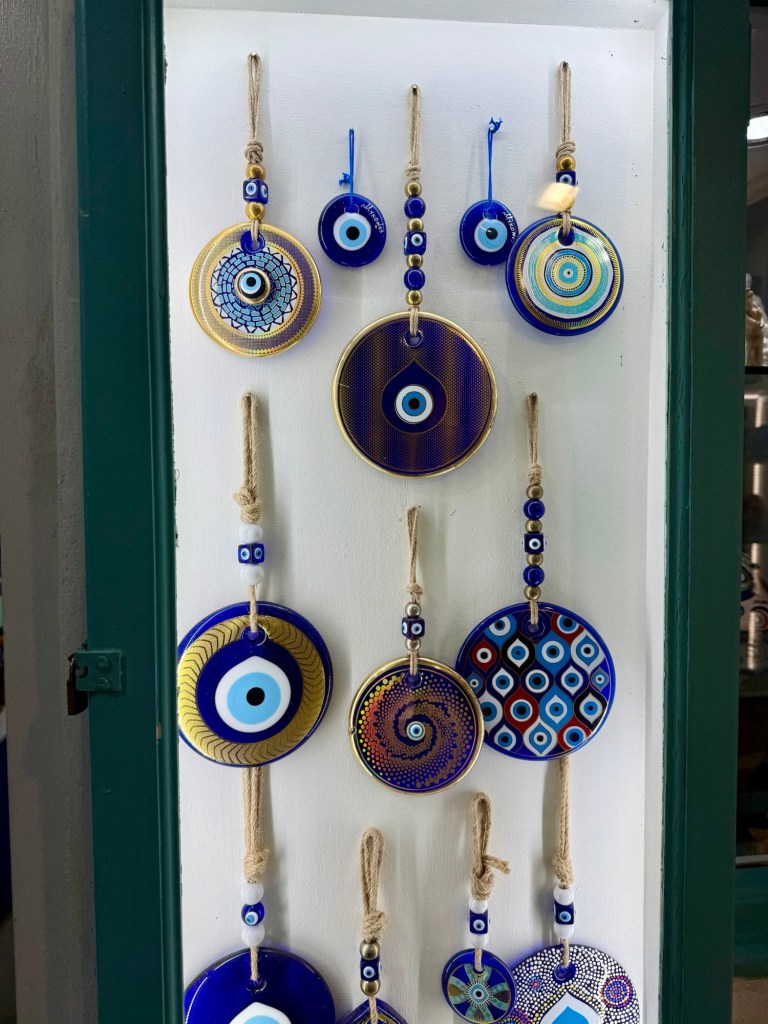
The first time I noticed them, I was wandering through a sun-drenched souvenir shop in Greece, jet-lagged and slightly overwhelmed by the sheer volume of blue glass staring back at me. Evil eyes. Hundreds of them. Dangling from keychains, embedded in bracelets, painted on ceramics, woven into textiles—an entire wall of unblinking cobalt gazes.
At first, I assumed it was just tourist kitsch, another trinket to hang on your rearview mirror alongside your Acropolis snow globe. But then I noticed something peculiar: the locals wore them too. Not ironically. Not as fashion statements. But with the same casual certainty you or I might wear a seatbelt.
That’s when the questions started multiplying. Why was this symbol everywhere? What made it so important that it appeared on newborn babies, fishing boats, and doorways alike? And why—in a world of endless protective symbols—had this particular blue eye endured for millennia?
So I did what any curious traveler does when confronted with mystery: I went down the rabbit hole. What I discovered wasn’t just a charming cultural tradition or a pretty piece of jewelry. It was a 5,000-year-old story of human fear, ingenuity, and our eternal quest to shield ourselves from the one thing no wall can keep out—envy.
The evil eye, it turns out, is one of humanity’s oldest and most widespread beliefs. And its journey from ancient curse to modern talisman is far stranger—and more fascinating—than anything I could have imagined standing in that Greek shop, surrounded by all those watchful blue eyes.
The Evil Eye: Ancient Curse, Modern Shield
A Glance That Could Shatter Lives
Imagine living in a world where a single look—fueled by envy or malice—could destroy your health, your fortune, even your life. This isn’t the plot of a supernatural thriller; it’s a belief that has gripped humanity for over 5,000 years and continues to captivate millions today.
The evil eye is rooted in the notion that a malevolent glare, typically driven by envy, can inflict a curse . What makes this superstition so fascinating is its near-universal reach. From the sun-scorched shores of ancient Mesopotamia to the marble temples of Greece and Rome, from the bustling bazaars of Turkey to modern celebrity closets—the evil eye has transcended geography, religion, and time itself.
Origins: When Gods Punished Pride
The earliest evidence traces back over 5,000 years to ancient Egypt and Sumer, where protective eye-idols were created . In these cradles of civilization, people believed that excessive praise or success attracted dangerous attention—not just from jealous neighbors, but from the gods themselves.
Ancient Greek writers like Plato, Hesiod, and Plutarch all attempted to explain this phenomenon . Plutarch offered a particularly vivid theory: the eyes were the primary source of deadly rays that sprang from within envious individuals . The Greeks called it “mati,” and it became so ingrained in their culture that the symbol appeared on drinking vessels as early as the 6th century B.C.
But here’s what’s truly remarkable: the belief existed not only in ancient Greece and Rome, but also in Jewish, Islamic, Buddhist, and Hindu traditions . Each culture developed its own narrative, yet the core remained chillingly consistent—a hostile gaze could bring ruin.
Fascinating Facts: The Devil in the Details
The Involuntary Curse: Not all evil eye beliefs paint the perpetrator as villainous. In some South American cultures, giving the evil eye is considered an involuntary act —you might accidentally curse a baby simply by admiring them too intensely. The solution? Attach a red ribbon to attract the gaze away from the vulnerable target.
Any Unexplained Illness? Blame the Eye: In ancient cultures, any disease without an obvious cause was attributed to the evil eye curse . Headache? Evil eye. Crop failure? Evil eye. Your cow stopped producing milk? Definitely the evil eye.
Protective Phalluses: The ancient Romans weren’t subtle about protection. They used phallic charms called fascinus as apotropaic objects against the evil eye, appearing on everything from personal jewelry to building decorations . The Latin verb “fascinare” (to cast a spell) gave us the English word “fascinate.”
The Left Side Rule: Some cultures believe the evil eye is best worn on the left hand or wrist because the left side is associated with receiving and absorbing energy —making it the ideal location to intercept negative forces before they reach you.
When Your Amulet Breaks: Turkish culture holds that when an evil eye bead cracks, the bad energy has been successfully diverted into the amulet , protecting you from harm. It must be immediately replaced to maintain your shield.

The Turkish Blue: More Than Just Pretty Glass
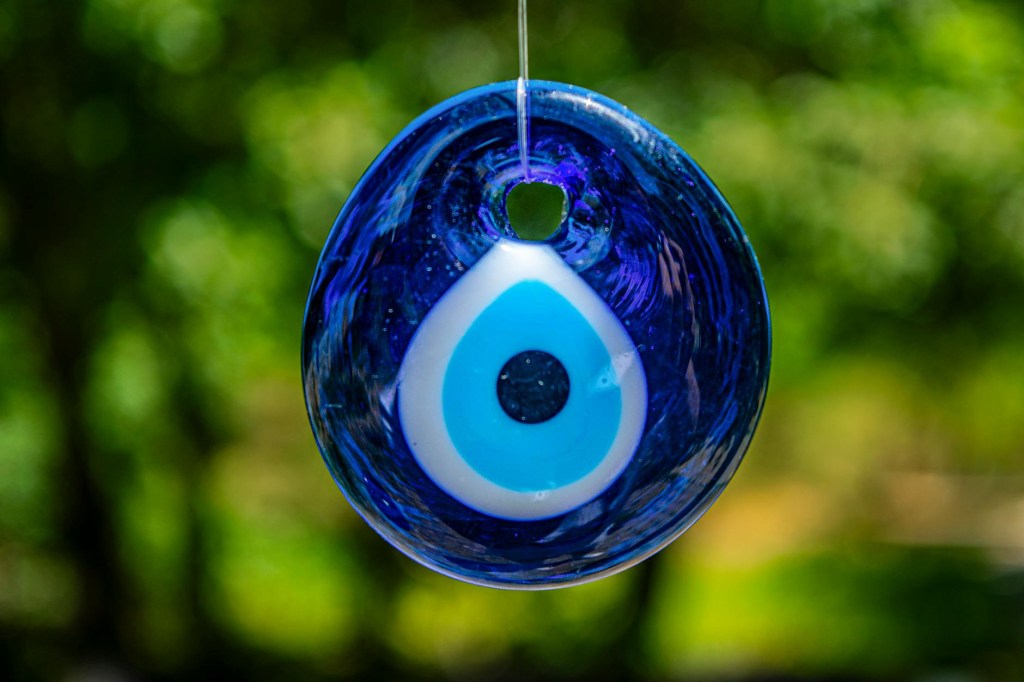
The Turkish created the Nazar Boncuk charm—characterized by a dark eye set against a blue background—to ward off evil spirits by staring back at the world . But why blue?
In Turkey, Greece, and surrounding regions, water symbolizes growth and prosperity in otherwise arid landscapes . The blue eye represents that life-giving force. Additionally, blue is associated with Tengri, the Turkish sky deity , adding layers of spiritual protection to the color choice. Today, in Turkey, the evil eye symbol is attached to anything that might attract envy—homes, offices, currency, newborn children, farm animals, and even building foundations .
Modern Significance: From Talisman to Trendsetter
Perhaps the most intriguing aspect of the evil eye is how seamlessly it has migrated from ancient apotropaic device to contemporary fashion icon—without losing its original power.
The Celebrity Effect: The Kardashians, Meghan Markle, Priyanka Chopra, and Rihanna have all been spotted wearing evil eye jewelry, dramatically increasing its appeal . Since 2020, evil eye jewelry has evolved from vacation souvenirs to everyday essentials . Meghan Markle’s blue topaz evil eye necklace famously sold out after a single photo appearance.
A Booming Market: The global spiritual jewelry market, which includes evil eye talismans, is projected to grow from $14.78 billion in 2024 to $21.12 billion by 2029 . This isn’t just a passing trend—it’s a cultural resurgence.
Why Now?: In our hyperconnected age of social media, where success is constantly on display and comparison breeds envy, the evil eye feels more relevant than ever. The idea that wealth, success, and praise can cause one’s downfall resonates strongly in contemporary celebrity culture .
The Manifesting Connection: Many believe wearing evil eye jewelry complements the practice of manifesting —the protective nature of the symbol aligns with focusing positive energy and deflecting negativity. In an era obsessed with mindfulness and intentional living, the evil eye has found new philosophical territory.
The Cultural Appropriation Debate
Not everyone celebrates the evil eye’s mainstream popularity. Some argue that commercialization has stripped the symbol of its sacred meaning, turning a genuine protective talisman into a hollow fashion accessory. When an ancient symbol becomes a TikTok trend, does it lose something essential?
Yet others counter that the evil eye’s 5,000-year survival is precisely because it adapts and spreads. The Roman Empire disseminated the belief throughout Europe, the Middle East, and North Africa, with each culture adapting it to their own worldview . Perhaps today’s celebrity endorsements are simply the latest chapter in an ongoing story of cultural evolution.
The Enduring Power of a Symbol
What makes the evil eye so captivating is that it addresses something fundamentally human: our vulnerability to others’ perceptions and the desire to protect what we cherish. In a world where envy can go viral and negativity spreads at the speed of a tweet, maybe we need that ancient blue eye now more than ever.
Whether you wear it as a spiritual shield, a fashion statement, or a connection to ancestral wisdom, the evil eye remains what it has always been—a reminder that sometimes, the oldest protections are the ones we still need most.




 Platnumkitty
Leave a comment