
Picture this: You’re scrolling through Instagram, and boom—another impossibly perfect photo of whitewashed buildings with cobalt blue doors, set against an endless azure sky. “Greece,” you think. But here’s the wild part: ancient Greeks might not have even called that sky blue.
Yeah, you read that right.
The color that now screams “Greece!” louder than a plate-smashing celebration has one of the strangest origin stories in cultural history. From Homer’s bizarre color blindness to dictator-mandated house paint, the significance of blue in Greek culture is way more interesting than you’d expect.
Let me take you on a journey through time, superstition, and accidental branding genius.
Ancient Greece: When Blue Didn’t Exist (Sort Of)
Here’s where things get weird. Ancient Greeks—the people who gave us philosophy, democracy, and the Olympics—apparently couldn’t see blue. Or could they?
Homer called the sea “wine-dark.” Not blue. Wine-dark. For centuries, scholars genuinely wondered if ancient Greeks were colorblind. Spoiler alert: they weren’t. They just thought about color completely differently than we do.
Instead of organizing colors by hue (red, blue, green), they categorized them by brightness—light versus dark. When they did use blue-ish words, they were super specific. Kyanos meant a dark, almost black-blue associated with mourning and the underworld (cheerful, right?). Glaukos described a shimmering grey-blue—think Athena’s piercing eyes or the glint of sun on waves.
So ancient Greeks knew blue existed. They just… weren’t that into it.
Fast forward a few thousand years, and blue is everywhere. What happened?

The Evil Eye: When Blue Became Your Bodyguard
Walk into any Greek home, shop, or tourist trap, and you’ll spot them: those bright blue glass eye charms dangling from doorways, pinned to babies’ clothing, swinging from rearview mirrors.
This is the mati—the evil eye charm—and it’s serious business.
The belief goes like this: someone gives you a jealous look (intentionally or not), and boom, you’re cursed with bad luck. The blue eye charm doesn’t just sit there looking pretty—it actively deflects that negative energy right back where it came from.
But why blue specifically? The theory is deliciously ironic. Blue eyes were historically rare around the Mediterranean, which made them exotic and slightly unsettling. People believed those with blue eyes were more likely to cast the evil eye, so wearing a blue charm was like fighting fire with fire—reflecting that powerful gaze back on itself.
It’s also seen as a protective, divine stare watching over you. Ancient meets practical. Very Greek.
The Virgin Mary’s Signature Color
If you’ve ever been inside a Greek Orthodox church (or stared at Byzantine icons in a museum), you’ve noticed: Mary is always wearing blue.
Not just any blue—a deep, rich, heavenly blue that practically glows against gold backgrounds.
In Orthodox iconography, blue represents the divine realm, the infinite mystery of heaven itself. For the Virgin Mary—the Theotokos, or “God-bearer”—that blue mantle is loaded with meaning. She’s human, yes, but she carried the divine within her. That blue is the visual representation of that impossible, sacred intersection.
Heaven meeting earth. Mystery wrapped in motherhood. All in one color.
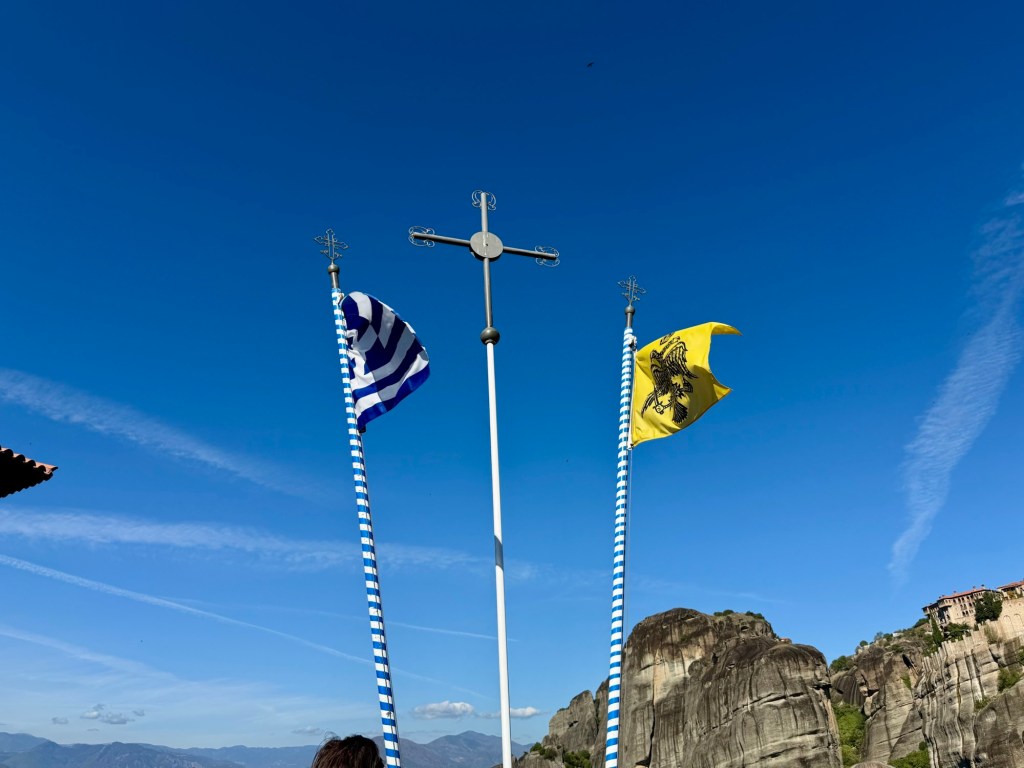
The Flag: Nine Stripes, One Revolutionary Cry
The modern Greek flag—those bold blue and white stripes with a cross in the corner—officially dates to 1822, right after the War of Independence.
Most people assume the blue represents the Aegean Sea and the endless Greek sky, while the white symbolizes purity, sea foam, and clouds. Pretty straightforward, right?
But here’s the cool part: those nine stripes aren’t random. They represent the nine syllables of the revolutionary war cry that echoed across Greece during the fight for freedom:
“E-lef-the-ri-a i Tha-na-tos”
Freedom or Death.
Five blue stripes, four white ones, nine syllables of defiance. Every time that flag waves, it’s shouting that motto into the wind.
Plot Twist: The Blue Houses Were a Government Mandate
Okay, this is where the story gets really good.
You know those iconic Cycladic islands—Santorini, Mykonos—with their dreamy white-and-blue buildings that launched a thousand travel blogs? That wasn’t some ancient aesthetic tradition passed down through generations.
It was basically a hygiene campaign gone viral.
The Cholera Panic of 1938
During the dictatorship of Ioannis Metaxas, Greece was hit with a cholera outbreak. Panicked officials ordered every house to be whitewashed with limestone, which acts as a natural disinfectant. Public health through paint—genius, honestly.
But here’s where it gets interesting. Islanders also had to paint their doors, windows, and shutters. The problem? Paint was expensive.
Enter loulaki—a cheap blue powder that every household already had for laundry (it’s a bluing agent that makes whites look whiter). People mixed it with plaster, slapped it on their shutters, and voilà: instant Greek island aesthetic.
The Junta Made It Law
If that origin story weren’t bizarre enough, the military junta that ruled Greece from 1967 to 1974 actually enforced this color scheme by law. They wanted uniformity. They wanted patriotism. They wanted every building to match the flag.
What started as a cholera response became legislated national branding.
And tourists? They ate it up. That blue-and-white combo became the visual shorthand for Greece, splashed across postcards, posters, and Instagram feeds worldwide.

From Invisible to Iconic
So here we are. Blue went from barely mentioned in ancient poetry to the single most recognizable symbol of modern Greece.
It protects you from evil. It represents the Virgin Mary. It waves on the flag as a battle cry for freedom. It coats entire islands in a color scheme born from disease prevention and dictatorship.
That’s the thing about culture—it’s never as straightforward as it looks. The stories behind the symbols are always messier, weirder, and more human than we expect.
Next time you see that perfect blue door in Santorini, you’ll know: it’s not tradition. It’s loulaki. It’s cholera panic. It’s accidental genius.
And somehow, it’s the most Greek thing ever.




 Platnumkitty
Leave a comment