Part 7 of the Cosmic Clarity-Lessons From the Wild Series
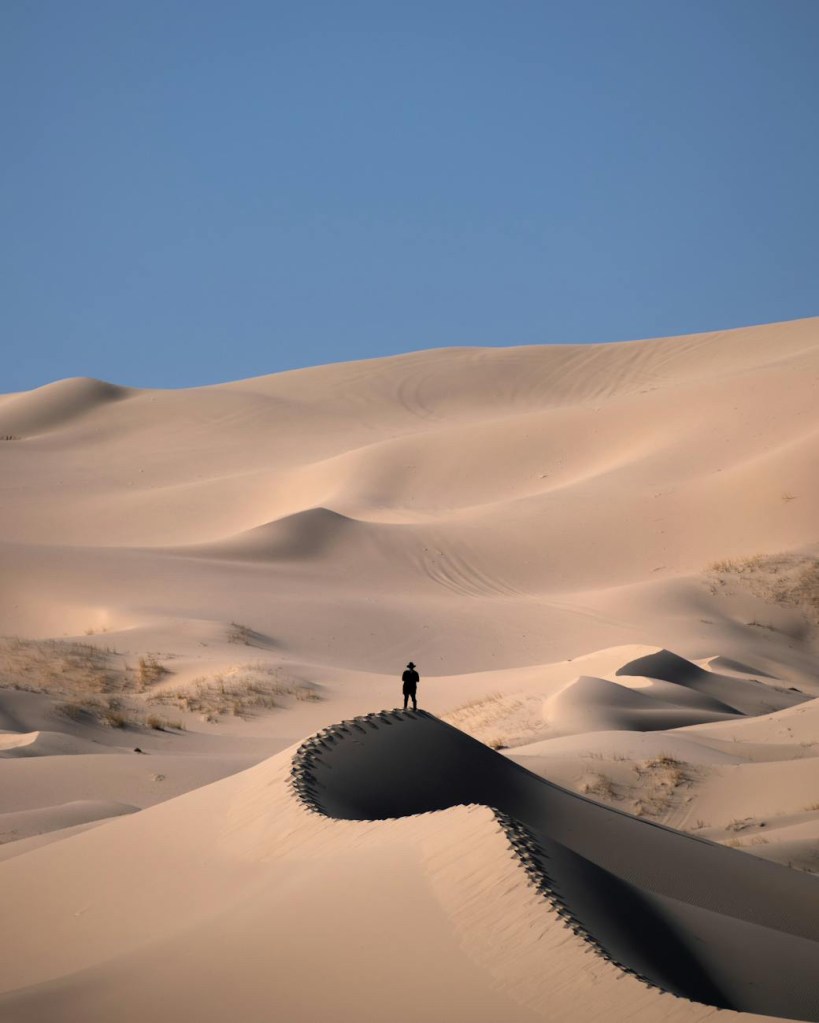
I thought the desert would feel barren.
That’s what everyone says, right? It’s empty. Desolate. A wasteland. Nothing there but sand and heat and absence.
But standing in the Mojave at sunrise, watching light paint the landscape in shades of rose and gold, I realized: they were all wrong.
The desert isn’t empty. It’s the opposite of empty.
It’s full—just not in the way we’ve been taught to recognize fullness.
No clutter. No excess. No noise. Just essence. Just what’s necessary. Just what’s true.
A single cactus holding more life than an entire overgrown garden. A lizard moving with more purpose than a hundred distracted humans. Silence so complete it feels like presence, not absence.
I’d come to the desert to escape. To get away from the too-muchness of everything. Too many choices, too many possessions, too many obligations, too many voices telling me who to be and what to want.
But the desert didn’t let me escape. It made me face something I’d been avoiding:
What if less isn’t deprivation? What if it’s clarity?
What if empty isn’t hollow? What if it’s spacious?
What if the life I’ve been building—full of so much stuff, so many commitments, so many things I thought I needed—is actually the thing that’s barren?
The Fullness We Mistake for Abundance
We’ve been sold a particular story about what abundance looks like:
Full calendars. Full closets. Full schedules. Full inboxes. Full lives.
More options, more possessions, more experiences, more connections, more everything.
The more you have, the more abundant you are. The fuller your life, the richer it is.
So we fill. And fill. And fill.
Until we’re so full we can’t breathe. So full we can’t think. So full we can’t feel what actually matters because there’s too much noise drowning out the signal.
Our homes are full of things we don’t use, don’t need, don’t even remember buying. We keep them “just in case.” Just in case of what? A future where we’re different people who suddenly need seventeen coffee mugs?
Our calendars are full of commitments we don’t want to keep, obligations we said yes to out of guilt, events we’re attending because we “should.” We’re so busy being busy we’ve forgotten what we’re busy for.
Our minds are full of information we don’t need, opinions we didn’t ask for, content we’re consuming but not digesting. We’re overfed and undernourished. Drowning in input with no space for output.
Our relationships are full of people we don’t actually connect with. Acquaintances we maintain out of obligation. Networks we’re “building.” Connections that are wide but not deep.
We call this abundance. The desert calls it clutter.
What the Desert Knows That We’ve Forgotten
Life doesn’t require excess to thrive. A saguaro cactus lives for 200 years in conditions that would kill most plants in a week. It doesn’t need constant watering. It doesn’t need rich soil. It doesn’t need perfect conditions. It needs very little—but what it needs, it gets deeply.
Space is not emptiness. The desert has vast open space. Miles of nothing but sand and sky. And in that space? Life figures out how to exist. How to adapt. How to thrive. Space isn’t the absence of something—it’s the presence of possibility.
What survives in harsh conditions is essential. The desert strips away everything that’s not crucial. Only what’s absolutely necessary makes it. That’s not deprivation—that’s clarity. That’s truth. That’s the essence of what actually matters.
Simplicity is sophisticated. A desert landscape looks simple. Sand, sky, a few plants, some rocks. But look closer and you see intricate ecosystems, complex relationships, profound beauty in the details. Simplicity on the surface. Depth underneath.
Scarcity creates value. Water in the desert isn’t taken for granted. It’s precious. Sacred. Every drop matters. When everything is abundant, nothing is valuable. When resources are scarce, you learn what actually matters.
Silence speaks. The desert is quiet. Not dead—quiet. And in that quiet, you can finally hear. Your thoughts. Your intuition. The truth you’ve been drowning out with noise.
I spent three days in the desert. Brought very little. Had even less to do. At first, my brain panicked at the emptiness. Then it settled. Then it opened.
And I could finally see clearly.
The Abundance I Found in Emptiness
Clarity. Without distraction, without clutter, without noise—I could think. Not overthink. Just think. Clearly. About what I actually wanted. What actually mattered. What I was filling my life with that didn’t serve me.
Presence. With nothing demanding my attention, I could be where I was. Not mentally somewhere else. Not planning the next thing. Just here. Just now. Turns out, that’s what I’d been looking for all along.
Spaciousness. Room to breathe. Room to feel. Room to exist without performing or producing. Space that isn’t empty—it’s open. Available. Mine.
Connection to myself. In the quiet, I could hear the quiet voice. The one that gets drowned out by everything else. The one that knows what I need. The one I’ve been ignoring because I’m too full of other voices.
Appreciation for what is. When there’s not much, you notice everything. The way light hits a rock. The smell after rain. The sound of wind. Not taking anything for granted because there’s not enough to be casual about.
Freedom from more. The desert doesn’t want more. It is what it is. And it’s enough. I didn’t need more experiences or more stuff or more anything. What I needed was less. Less so I could see what was already there.
The Practice of Subtraction
We’re taught that growth is addition. Add more skills. More experiences. More possessions. More achievements.
But the desert teaches: growth is also subtraction.
Stripping away what’s not essential. Removing what’s in the way. Clearing the clutter so the truth can emerge.
I came home and emptied my closet. Not just decluttered—actually emptied. Pulled everything out. Only put back what I actually wore, actually loved, actually needed. The rest? Gone. Not to a “maybe someday” box. Actually gone.
The result? A closet with space. Where I can see what I have. Where getting dressed isn’t overwhelming. Where less actually feels like more.
I emptied my calendar. Looked at every commitment and asked: Do I actually want to do this? Or am I doing it out of obligation, fear, or the belief that busy = important?
Cancelled things. Said no to things. Created blocks of nothing. Not because I’m lazy. Because I need space to exist in, not just tasks to complete.
I emptied my social media. Unfollowed everyone who made me feel “less than.” Whose content was noise, not signal. Whose posts triggered comparison instead of inspiration.
The result? A feed that feels nourishing instead of depleting. Less input. Better input. Space for my own thoughts instead of everyone else’s.
I emptied my friendships. Not cruelly. But honestly. Stopped maintaining relationships out of history or obligation. Stopped saying yes to people who drain me. Let some friendships fade naturally instead of forcing them.
The result? Deeper connections with fewer people. Quality over quantity. Real intimacy instead of surface-level maintenance.
I emptied my ambitions. Looked at my goals and asked: Whose dream is this? What am I chasing that I don’t actually want? What looks impressive but feels hollow?
Let some goals go. Not because I failed. Because they were never mine.
Living Like the Desert
Do more with less. A cactus stores water for months. Uses every drop efficiently. Thrives in conditions that seem impossible. That’s not deprivation—that’s mastery. You don’t need more resources. You need to use the ones you have more intentionally.
Create space intentionally. The desert’s beauty is in its spaciousness. What if you designed your life the same way? Not filling every gap. Leaving room. White space in your calendar. Empty space in your home. Silence in your day.
Only keep what serves you. In the desert, everything that exists there has earned its place. It serves a purpose. It belongs. What if you applied that standard to everything in your life? Does this serve me? Does it belong? Or am I keeping it out of guilt, fear, or habit?
Find beauty in simplicity. A desert sunset isn’t cluttered. A rock formation isn’t excessive. The beauty is in the clarity, the clean lines, the essence. Your life doesn’t need embellishment to be beautiful. It needs you to remove what’s obscuring the beauty that’s already there.
Adapt to constraints. The desert is harsh. But life doesn’t give up—it adapts. Finds creative solutions. Works within limits. What if your constraints aren’t problems to solve but parameters to create within?
Value what’s scarce. In a world of abundance, we take everything for granted. The desert reminds us: treat resources as precious. Time is limited. Energy is finite. Attention is scarce. Stop wasting them on what doesn’t matter.
The Questions That Strip Away the Excess
For possessions:
- Do I use this regularly?
- Does this add value to my life?
- Would I buy this again today?
- If I lost this, would I replace it?
- Is this here because I love it or because I feel obligated to keep it?
For commitments:
- Do I actually want to do this?
- Am I saying yes out of desire or obligation?
- Does this align with my values and priorities?
- Would I be relieved if this got cancelled?
- Is this feeding me or depleting me?
For relationships:
- Do I feel more myself or less myself around this person?
- Does this relationship feel reciprocal?
- Am I maintaining this out of history or current connection?
- Do we have anything in common anymore?
- Does this person know the real me?
For goals:
- Is this my dream or someone else’s?
- Am I pursuing this because I want it or because it looks good?
- Would I still want this if no one knew about it?
- Is this goal serving my current season or an old version of me?
- What am I sacrificing for this? Is it worth it?
For everything:
- Does this simplify my life or complicate it?
- Does this create space or fill it?
- Is this essential or excess?
- Does this bring me closer to who I actually am or further away?
Your Practice This Week
The One-Thing Purge:
Choose one area (closet, junk drawer, digital folder, category of commitment). Empty it completely. Only put back what’s essential. Notice how different it feels.
The Calendar Cleanse:
Look at your next two weeks. Identify one commitment you’re doing out of obligation, not desire. Cancel it. Create space instead of filling it. Notice what that space makes possible.
The Digital Desert:
Unfollow 20 accounts that don’t serve you. Delete 10 apps you don’t need. Turn off notifications for everything except the truly essential. Create digital emptiness.
The Silence Practice:
Spend one hour in complete silence. No music, no podcast, no TV, no input. Just silence. Notice what emerges in the space. Notice how hard it is to not fill it.
The Necessity Inventory:
For 24 hours, notice everything you use. Everything. Then look around at everything you own. How much of it did you actually touch? That’s the gap between what you have and what you need.
The One-Week Challenge:
Choose one thing you think you need. Go a week without it. Phone, social media, shopping, TV, whatever. Notice: was it necessary? Or were you just used to having it?
The Desert Visualization:
Close your eyes. Imagine your life as a landscape. How cluttered is it? How much excess? Now imagine it as a desert—clean, spacious, essential. What would have to go? What would remain?
The Paradox of Emptiness
Here’s what I learned in the desert:
Empty doesn’t mean lacking. It means available.
Space doesn’t mean absence. It means possibility.
Less doesn’t mean deprived. It means focused.
Simple doesn’t mean boring. It means essential.
Nothing doesn’t mean void. It means open.
The fullness I’d been chasing—the packed calendar, the full closet, the endless options, the constant stimulation—wasn’t making me rich. It was making me overwhelmed.
The emptiness I’d been avoiding—the space, the silence, the simplicity, the less—wasn’t poverty. It was freedom.
The desert is abundant precisely because it’s empty. Because in that emptiness, everything essential can thrive. Everything meaningful can emerge. Everything true can be seen clearly.
Your life doesn’t need more. It needs space for what matters.
Your closet doesn’t need to be full. It needs to contain what you actually wear.
Your calendar doesn’t need to be packed. It needs room for what you actually want to do.
Your mind doesn’t need more input. It needs space to process what’s already there.
Your relationships don’t need to be numerous. They need to be real.
The desert has been thriving for millions of years with very, very little.
Maybe we can too.
The Life on the Other Side of Subtraction
I can’t promise that living with less will solve all your problems.
But I can tell you what happened when I started clearing the excess:
I could breathe. For the first time in years, I had room to breathe.
I could think. Without constant noise, my mind could actually form coherent thoughts.
I could feel. Not just anxiety and overwhelm, but actual emotions. Joy. Peace. Contentment.
I could choose. When you have fewer options, choices become clearer. When you have less stuff, you appreciate what remains.
I could rest. Because I wasn’t constantly managing, maintaining, and organizing all the excess.
I could be myself. The real me. Not the person performing abundance. Not the person trying to keep up. Just me.
The desert didn’t teach me to want less. It taught me to see clearly what I actually needed.
And it turns out, I need a lot less than I thought.
What excess are you carrying? What would remain if you stripped everything down to essence? What’s hiding in the clutter that you’d finally see in the emptiness?


 Platnumkitty
Leave a comment