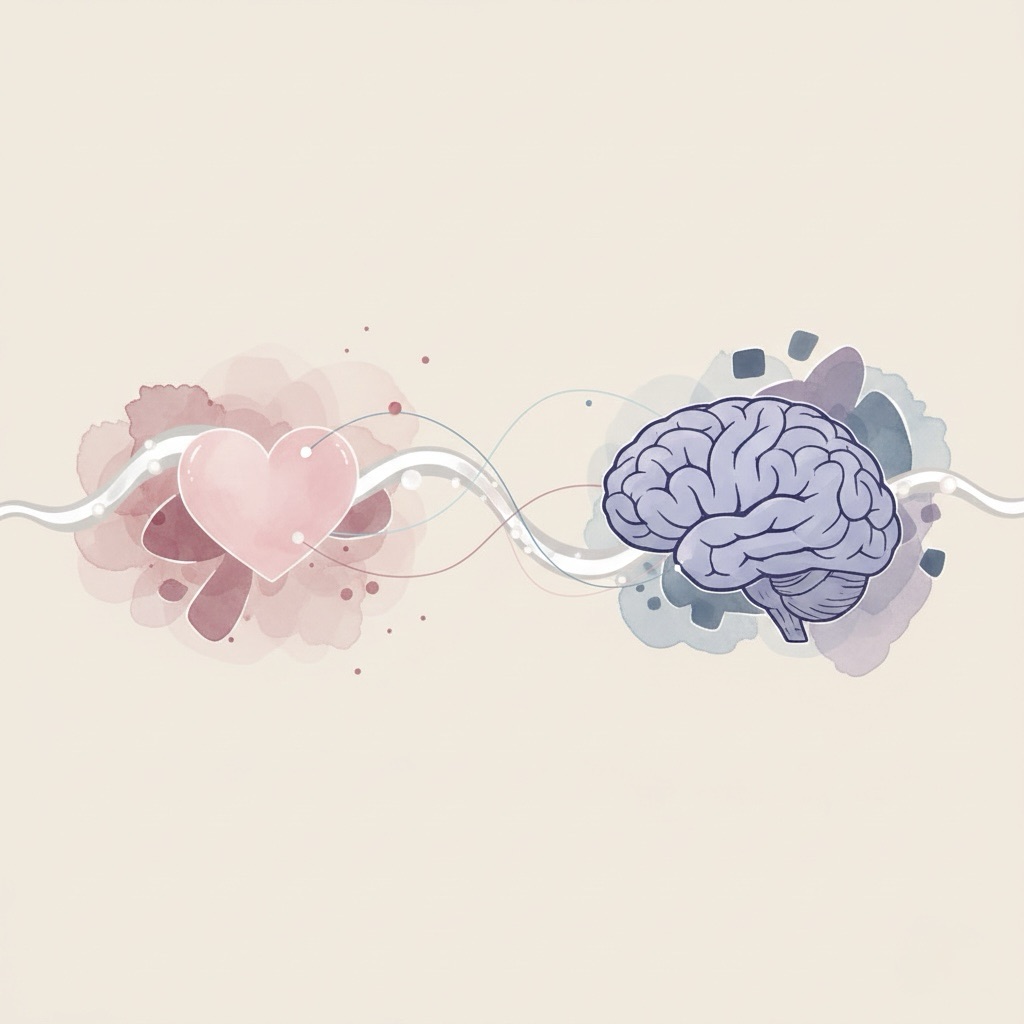
There are moments when a truth arrives so quietly, so completely formed, that you wonder how long it’s been waiting for you to notice it. That happened to me today when this thought emerged: “I’m convincing my brain about something my heart already knew.”
And then, just as suddenly, came its mirror: “My brain knows something my heart can’t deny.”
Both felt true. Both felt impossible. And somehow, I was standing in the middle of this contradiction, being pulled in every direction at once—logically, energetically, emotionally.
Maybe you know this feeling too.
The Familiar Tug-of-War
We talk about the heart versus the head like they’re opponents in a debate, each arguing their case, waiting for us to pick a winner. Your heart whispers what it wants, what it fears, what it’s drawn to without explanation. Your brain presents the facts, maps out the consequences, builds protective walls out of logic and past experience.
And you? You’re stuck listening to both, trying to make a decision that somehow honors them equally.
The hardest decisions aren’t between good and bad—they’re between two truths that refuse to coexist. Your heart knows you need to leave something that no longer serves you, while your brain catalogs all the reasons why staying is safer. Or your brain sees clearly that a path isn’t sustainable, while your heart clings to the hope that maybe, just maybe, things will change.
This isn’t weakness. This is being human.
When Logic Meets Longing
What makes this conflict so exhausting is that neither side is wrong. Your heart isn’t being naive when it feels what it feels—emotions carry wisdom that logic can’t always access. They tell you about your values, your boundaries, what matters to you beneath all the noise. Your heart remembers who you are when you strip away the “shoulds” and the fear.
And your brain isn’t being cold or cynical when it raises concerns. It’s trying to protect you, drawing on everything you’ve learned, every pattern you’ve recognized, every time you’ve been hurt before. It wants you to survive, to thrive, to avoid unnecessary pain.
The problem is that they speak different languages. And when you’re being pulled in multiple directions—logically, energetically, emotionally—it can feel like you’re being torn apart.
The Weight of Difficult Decisions
Some decisions demand that we sit in this discomfort for a while. We want clarity, a neat answer, a path forward that feels completely right. But sometimes the answer is messy. Sometimes choosing means accepting loss alongside gain. Sometimes honoring one truth means disappointing another part of yourself.
This is where we often get stuck—not because we don’t know what to do, but because any choice feels like a betrayal. Moving forward feels wrong. Staying still feels wrong. We cycle through the same thoughts, hoping that if we just think about it one more time, the conflict will resolve itself.
But what if the conflict isn’t something to solve? What if it’s something to move through?
Working Through the Conflict With Compassion
Here’s what has helped me when I find myself in this space between knowing and feeling:
Create space for both voices. Don’t rush to silence either your heart or your brain. Set aside time to really listen to each one. Write out what your heart is saying without editing or judging it. Then write what your brain is concerned about. Let both truths exist on the page together. Sometimes simply acknowledging the conflict eases its grip.
Notice what your body knows. Our bodies often hold wisdom that our minds and hearts are still processing. When you think about each option, what do you feel physically? Tightness in your chest? A sense of expansion? Heaviness? Your body doesn’t lie, and it doesn’t deal in “shoulds”—it just responds to what feels aligned or misaligned.
Ask better questions. Instead of “What should I do?”, try “What am I most afraid of?” or “What would I choose if I trusted myself completely?” or “What does the version of me I’m becoming need right now?” These questions cut through the noise and get to the heart of what’s really driving the conflict.
Give yourself permission to not have it all figured out. You don’t need perfect clarity to take the next small step. You don’t need to know exactly where you’ll end up. Sometimes the path only reveals itself when you start walking. Trust that you can make one decision, learn from it, and adjust as you go.
Be gentle with the in-between. This liminal space—where you’re no longer where you were but not yet where you’re going—is uncomfortable by design. You’re supposed to feel uncertain here. That doesn’t mean you’re doing it wrong. It means you’re in the middle of something real, something that matters. Honor that.
Remember that choosing isn’t the same as having no doubt. You might never feel 100% certain. You might always wonder “what if.” But waiting for absolute certainty is often just another way of staying stuck. At some point, you have to trust yourself enough to move forward, even with the doubt still present.
Both Can Be True
Here’s what I’m learning: sometimes “I’m convincing my brain about something my heart already knew” and “My brain knows something my heart can’t deny” aren’t contradictions. They’re the same truth from different angles.
Maybe your heart knows you deserve better, and your brain is finally catching up. Maybe your brain sees reality clearly, and your heart is learning to accept it. Maybe they’re both trying to protect you in their own way, and your job isn’t to pick a side but to find a path that honors both.
The conflict doesn’t always mean you’re stuck. Sometimes it means you’re standing at the edge of growth, and growth always involves some tension between who you’ve been and who you’re becoming.
You don’t have to have it all figured out. You don’t have to force a resolution before you’re ready. You just have to keep listening—to your heart, to your brain, to your body, to that quiet voice underneath it all that already knows what you need.
And then, when you’re ready, you take the next step. Not because you’re certain, but because you’re brave enough to trust yourself through the uncertainty.
That’s enough. You’re enough.
What conflicts are you navigating right now? Remember, you don’t have to navigate them alone, and you don’t have to navigate them perfectly. Just compassionately, one moment at a time.



 Platnumkitty
Leave a comment