Post 4 of the Explore Sedona Series
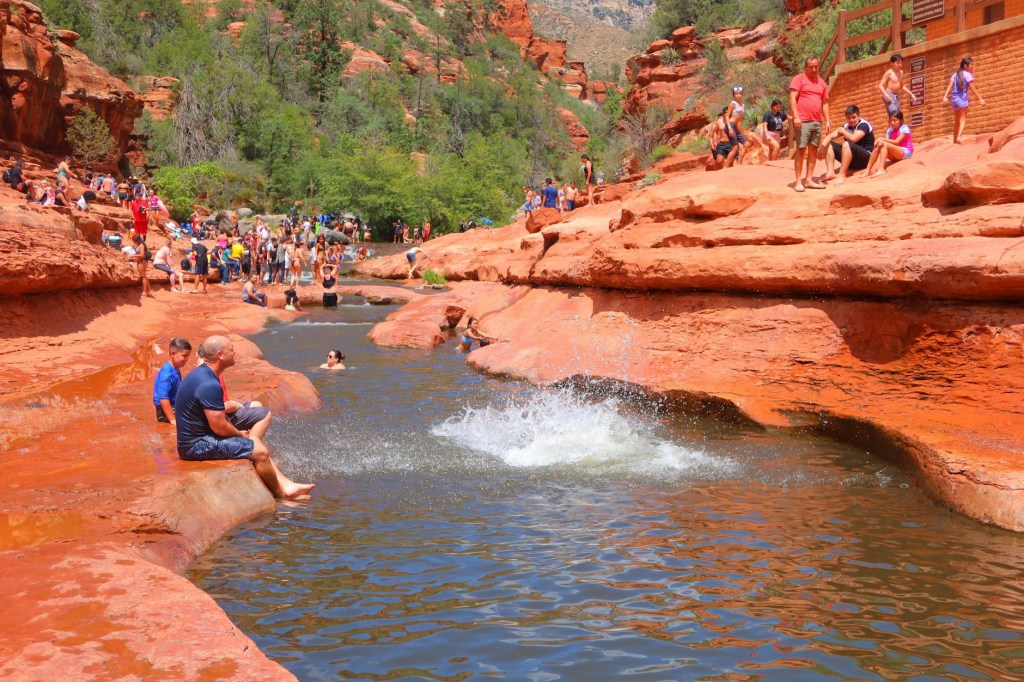
There are certain days that get etched into your family’s collective memory. The ones you’ll bring up at dinner tables years from now, retelling the stories until everyone groans, “Not the Slide Rock story again!”
For us, that day happened last spring in Sedona’s Oak Creek Canyon.
The weather was that perfect kind of warm—the sun kissing your shoulders while a cool breeze kept things comfortable. The water? Gloriously refreshing without being bone-numbingly cold. And the crowds? Blessedly manageable. It was one of those golden days where everything clicks, and you find yourself already planning the return trip before you’ve even left the parking lot.
Welcome to Slide Rock State Park, folks. And trust me, it lives up to the hype.
What Exactly IS Slide Rock?
If you haven’t been, let me paint you a picture. Imagine an 80-foot-long natural chute carved into smooth sandstone by thousands of years of flowing water . Now imagine sliding down that chute on your back (or your seat, or your belly—no judgment here) and plopping into a cool, clear pool at the bottom. Then imagine doing it again. And again. And again.
That’s Slide Rock. It’s nature’s original water park, and it’s been making Arizonans smile for nearly a century .
The rocks are naturally smooth, but here’s the secret ingredient: algae. That thin layer of slippery green stuff is what creates the slick surface that sends you gliding down the 80-foot chute . The slide itself is about 2.5 to 4 feet wide with a gentle 7% decline—steep enough to be exciting, gentle enough that even the kids (with supervision) can join the fun .
Beyond the main slide, the park offers about a third of a mile of creek access with swimming holes, shallow wading areas perfect for little ones, and rock ledges that double as natural diving boards for the brave souls in your group .
A Little Slice of History (Yes, There Were Apples!)
Here’s something I didn’t know before we visited: Slide Rock isn’t just a swimming hole—it’s also a piece of living history.
Back in 1907, a man named Frank Pendley homesteaded this land and did something pretty remarkable. He figured out how to irrigate the area using Oak Creek’s water, blasting tunnels into the sandstone and building metal flumes to channel water to his crops . He planted apple orchards, and by 1912, the Pendley Homestead was thriving .
The family built rustic cabins in the 1933 to accommodate early tourists—people have been flocking here for generations . They farmed the land until 1985, when they sold it to the Arizona Parklands Foundation, which then transferred it to the state . Slide Rock State Park officially opened in October 1987 .
Today, you can still wander through the historic apple orchard, peek at the old cabins, and explore the packing shed where apples were sorted for market . The Pendley Homestead was added to the National Register of Historic Places in 1991 . And if you visit in September or October, you can even pick apples right from the trees during the annual Slide Rock Apple Festival .
There’s something special about swimming in the same creek that’s been cooling off visitors for nearly a hundred years, surrounded by the same red rocks that have watched over this canyon for millions of years.
Our Day in the Water
We visited in late spring, and honestly? I think we nailed the timing.
The weather was warm enough that the water felt incredible—refreshing but not shocking. Oak Creek stays cool year-round, ranging from about 50°F in spring to 65°F in late summer . That crisp mountain water is the perfect antidote to the Arizona sun.
The kids took to the natural slide like little otters. There’s something magical about watching your children discover the pure, simple joy of sliding down a rock into a swimming hole. No screens. No batteries. Just sun, water, and laughter echoing off canyon walls.
For the thrill-seekers in our group (the kids), the cliff jumping areas were irresistible. There’s something simultaneously terrifying and exhilarating about launching yourself off a red rock ledge into the deep pool below. The sound of your friends cheering, the splash of impact, the rush of surfacing and yelling “AGAIN!”—it’s pure, uncomplicated joy.
And the scenery, y’all. The SCENERY.
Slide Rock sits at about 4,900 feet elevation in Oak Creek Canyon, surrounded by those iconic red rock formations that make Sedona famous . The combination of crimson cliffs, green ponderosa pines, and crystal-clear water is almost absurdly photogenic. I must have taken a hundred photos, and not a single one captures what it actually feels like to be there.
The Parking Puzzle (Let’s Talk About It)
Okay, let’s get real for a minute. I promised actionable advice, and here’s the biggest piece: the parking lot is not that big.
We arrived mid-morning and managed to snag a spot, but we could see the lot filling up fast. During peak season (May through September), the lot often fills by mid-morning, after which the park operates on a one-in, one-out basis . That means you could end up sitting in your car in a line, waiting for someone else to leave before you can enter.
Here’s what I wish someone had told us before we went:
Go early. Aim to arrive right when the park opens at 8 AM . The early birds get the parking spots AND the best spots along the creek.
Late spring and early fall are golden. We visited in late spring and found the sweet spot—warm weather, cool water, and manageable crowds. Peak summer (July-August) is packed, with temperatures hitting 90-100°F and afternoon thunderstorms possible . September and October offer beautiful autumn colors and fewer people .
Weekdays are your friend. If you can swing a Tuesday or Wednesday visit instead of a Saturday, do it. The difference is dramatic .
Pack your patience. Even if you hit a line, remember that people are coming and going all day. The wait might not be as long as it looks .
As of 2025, entry fees are around $30 per vehicle, but fees can vary by season and holidays, so check the official Arizona State Parks website before you go . Cash and cards are accepted at the entry station.
What to Bring (and What to Leave Behind)
We learned a few things through trial and error. Here’s your packing list:
Water shoes. This is non-negotiable. The rocks are slippery, and the creek bottom can be uneven. Water shoes give you traction and protect your feet from cuts .
Old swimsuits. The sandstone can be abrasive. Leave the fancy new suit at home and wear one you don’t mind getting a little roughed up .
Sunscreen and lots of it. You’re at high elevation, in the water (which reflects sunlight), and likely spending hours outside. Reapply often .
A cooler with lunch and plenty of water. There’s a small convenience store near the slide area with drinks, ice cream, and snacks, but for real meals, you’ll want to bring your own . Picnic areas with tables and shade are available .
Towels and a change of clothes. Obvious, but easy to forget when you’re rushing out the door .
NO glass containers. They’re strictly prohibited, and for good reason—broken glass and bare feet do not mix .
Beyond the Slide: Hiking and Exploring
When you need a break from the water (does that ever happen?), Slide Rock offers three short hiking trails, all less than a third of a mile :
· Pendley Homestead Trail (0.25 miles): An easy loop through the historic homestead with interpretive signs about the agricultural history .
· Slide Rock Route (0.3 miles): Follows Oak Creek to the slide area with multiple water access points .
· Clifftop Nature Trail (0.25 miles): Provides panoramic canyon views from above .
We took the Clifftop Trail late in the afternoon and watched the light shift across the canyon. The red rocks caught the golden hour sun and absolutely glowed. It was the perfect way to end our day.
Movie Magic and Fun Facts
Here’s a fun tidbit for your next trivia night: Slide Rock has served as a backdrop for several Hollywood films. John Wayne’s 1946 film “Angel and the Badman” was shot here, along with “Broken Arrow” (1950) starring James Stewart and “Gun Fury” (1953) with Donna Reed and Rock Hudson . Interpretive signs throughout the park highlight areas used in these classic Westerns .
Another cool fact: the park attracts over 300,000 visitors annually and has been named one of “America’s Top 10 Swimming Holes” by the Travel Channel multiple times .
Making Memories (and Planning Your Return)
As we packed up our coolers, wrangled damp towels, and herded sun-kissed kids toward the car, one thing was clear: we’d made memories that would last.
The drive back to Sedona was quiet in that contented way—everyone tired, sun-warmed, and happy. And somewhere between the creek and the highway, we started talking about when we could come back.
Next time, we’ll arrive even earlier. Next time, we’ll bring more snacks. Next time, we’ll try that higher jump.
But mostly, next time, we’ll do it all over again. Because some places are worth returning to. And Slide Rock? Slide Rock is definitely one of them.
Your Actionable Guide to Visiting Slide Rock
Location: 6871 N State Route 89A, Sedona, AZ 86336 (7 miles north of Sedona, 25 miles south of Flagstaff)
Hours: 8:00 AM – 7:00 PM (peak season), with no entry after 6:00 PM
Fees: Approximately $30 per vehicle (check azstateparks.com for current rates)
Best Times to Visit:
· Late Spring (May-June): Ideal weather, manageable crowds
· Early Fall (September-October): Cooler temps, fall colors, fewer people
· Weekdays: Always less crowded than weekends
Pro Tips:
· Arrive by 8 AM to secure parking
· Wear water shoes and old swimsuits
· Pack a picnic and plenty of water
· Supervise children closely—no lifeguards on duty
· Bring cash (cards accepted, but backup is always good)
Phone: (928) 282-3034
Website: azstateparks.com/slide-rock

 Platnumkitty
Leave a comment