Post 5 of the Explore Sedona Series
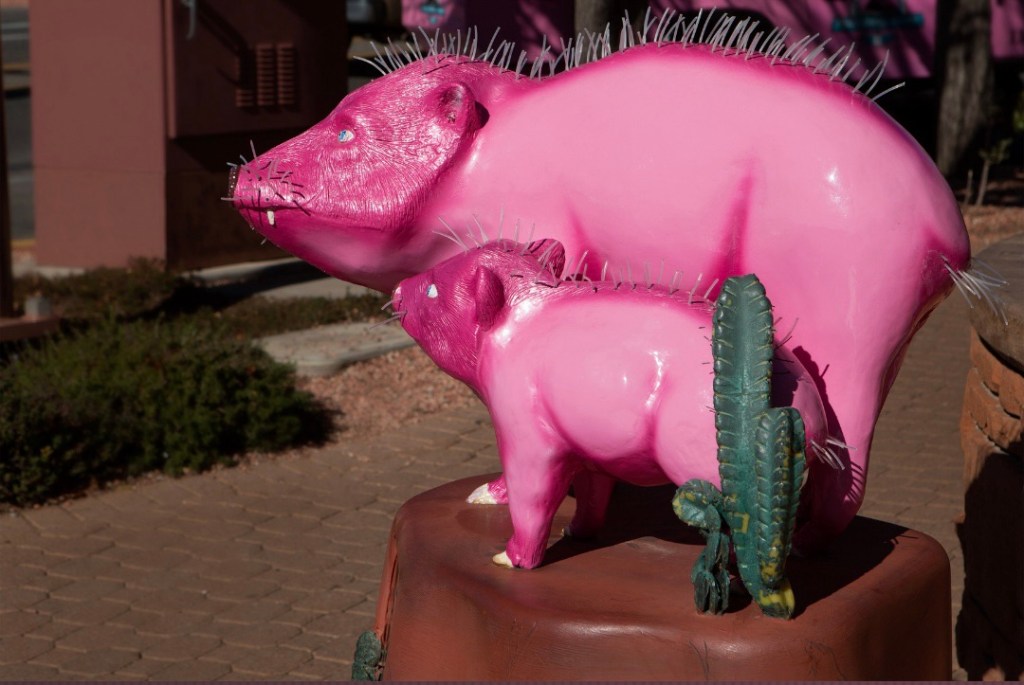
If you think Sedona is just about red rocks and vortex energy, let me tell you about the most delightful surprise waiting for you on every street corner, outside boutique shops, and tucked into unexpected alcoves throughout downtown: a parade of whimsical, colorful, larger-than-life javelina sculptures that have become as iconic to this desert town as the painted cliffs themselves.
Trust me—once you spot your first bright pink javelina or stumble upon a pair decorated with intricate Southwest mosaics, you’ll find yourself on an impromptu scavenger hunt that adds a whole new layer of magic to your Sedona adventure.
What’s a Javelina, and Why Are They Everywhere?
First things first: if you’re not from the Southwest, you might be wondering what the heck a javelina even is. These creatures—also called peccaries or, less flatteringly, “skunk pigs”—are native desert dwellers that look like wild pigs but are actually a completely different species. They roam Sedona in groups, digging up lawns for grubs, munching on prickly pear cactus (spines and all!), and generally making themselves part of the local scenery.
They’re stubby-legged, bristly-haired, and have a distinctive musky smell that announces their presence before you even see them. In short: they’re perfectly imperfect, which makes them absolutely perfect for Sedona.
So when the city decided to launch a major public art project in 2005, the javelina was the obvious choice. Native, beloved, quirky, and unmistakably Southwestern—what better ambassador for this creative community?
The Birth of “Javelinas on Parade”
Here’s how it all started: Back in 2005, Sedona was facing some highway construction that threatened to discourage tourism. The Sedona Chamber of Commerce and Sedona Arts Festival got creative, taking inspiration from Chicago’s famous “Cows on Parade” and asking themselves: what if we filled the town with art so compelling that people would come despite the construction?
Enter local sculptor Barbara R. Brown, a talented artist who had been teaching and creating in Sedona for years. She crafted the original life-size javelina molds—a mother named Mabel and her baby, Oscar—and then the real magic began.
Fifty different artists were commissioned to transform these blank canvases into works of art. Painters, ceramicists, metalworkers, glass artists, and assemblage creators all brought their unique visions to life. Local businesses sponsored pairs for $2,000, chose their artists, and proudly displayed their javelinas in front of their storefronts.
The result? One hundred individual sculptures scattered across Greater Sedona, each one a completely unique work of art, each one telling its own story.
The Creativity is Absolutely Wild
What I love most about the Javelinas on Parade is the sheer imagination on display. These aren’t cookie-cutter statues with minor variations—they’re wildly different creative expressions that range from whimsical to profound, hilarious to beautiful.
Take “Hairalina,” for instance—a bright bubblegum-pink mother and baby javelina created by artist Liam Herbert. She’s stationed (appropriately) in front of the Pink Jeep Tours headquarters, and she’s exactly as fabulous as you’d imagine. Her shocking pink hue against Sedona’s red rocks is the kind of thing that makes you stop in your tracks and laugh out loud.
Then there’s “Have-Aloha,” Andrea Smith’s mixed media creation that brings tropical vibes to the high desert. Some javelinas are covered in intricate tile mosaics that shimmer in the Arizona sun. Others are painted with traditional Native American patterns, honoring the land’s indigenous heritage. Some are sleek and modern, others rustic and earthy.
Every single one is worth finding.
The Hunt is Half the Fun
After the initial 18-month exhibition ended in 2007, the javelinas were auctioned off to benefit local arts programs. Many were purchased by the businesses that sponsored them, which means they’ve become permanent fixtures throughout downtown Sedona.
And here’s where your adventure begins: there’s no official map. No guided tour. Just you, the streets of Sedona, and the thrill of discovery.
We’ve made it our personal mission to photograph as many as we can find each time we visit. We’ve discovered them peeking out from garden courtyards, standing guard outside art galleries, welcoming guests at hotel entrances, and posing in front of restaurants (the Cowboy Club might even have one—I’ll have to check next time!).
It turns an ordinary shopping stroll into a treasure hunt. You’ll find yourself peering down side streets, doubling back when you think you spotted a flash of color, and asking locals, “Have you seen any javelinas around here?” Trust me, they’ll know exactly what you mean and will often point you toward a favorite.
Why These Statues Matter
On the surface, the Javelinas on Parade might seem like just a cute tourist attraction. And sure, they’re definitely Instagram-worthy (more on that later). But there’s something deeper happening here.
This project represents Sedona’s soul as a community that lives and breathes art. The city doesn’t just put art in galleries where you have to buy a ticket to see it. Art is everywhere—on the streets, in front of businesses, part of the daily landscape that both visitors and residents experience.
It’s democratic. It’s accessible. It’s joyful.
The javelinas also represent collaboration between artists and businesses, between creativity and commerce, between preservation and progress. They turned a potential tourism slump into a celebration. They gave fifty local artists paid commissions and lasting exposure. They raised funds for arts education programs that continue to benefit the community.
And nearly twenty years later, they’re still bringing smiles to thousands of faces every year.
The Real Javelinas: A Quick Primer
Since we’re talking about javelina art, let me give you the real scoop on the living, breathing creatures that inspired it all.
Real javelinas are something special. Despite looking like wild boars, they’re actually peccaries—a completely different family native to the Americas. They travel in groups (called “squadrons,” which is adorable), with an alpha male leading the pack and anywhere from six to thirty members tagging along.
You’ll often smell them before you see them—they have scent glands that produce a distinctive musky odor. It’s… memorable. But it’s also part of their charm, in a weird desert-wildlife kind of way.
They’re generally skittish around humans and will run away if given the chance. But if you corner them or get between a mother and her babies? They can get aggressive. So admire from a distance, never try to feed them (seriously, don’t), and appreciate that these bristly, snorting, cactus-munching creatures are perfectly adapted to survive in the harsh Sonoran Desert.
When you see a painted javelina statue posing elegantly on a street corner, remember that the real version is probably somewhere nearby, rooting through someone’s garden in search of grubs and generally being a chaotic desert gremlin. The contrast is delightful.
Creating Your Own Javelina Adventure
Ready to start your own javelina hunt? Here are my tips for making the most of this unexpected Sedona experience:
Start in Uptown Sedona: The highest concentration of javelinas is in the main tourist areas along Highway 89A. Begin near the galleries and shops, and work your way through the streets.
Keep Your Eyes Open: Some are front and center. Others are tucked into courtyards, beside building entrances, or in spots you’d walk right past if you weren’t looking. Part of the fun is the surprise of discovery.
Ask Locals: Shop owners and restaurant staff know where their neighborhood javelinas are and love sharing. It’s a great conversation starter, and you’ll often get stories about “their” javelina’s personality or history.
Photograph Them All: Make it a personal challenge. Create an album. Share them on social media. Some people try to find as many as possible in one visit. Others spread it out over multiple trips, making each Sedona adventure a continuation of the hunt.
Learn the Stories: If you can, ask about the artist who created each piece. Some businesses have plaques or information. The personal touches and creative decisions make each sculpture even more interesting.
Visit at Different Times of Day: The lighting changes everything. A javelina that looks cheerful in morning sun might be dramatically shadowed at sunset. The red rock backdrop shifts from soft pink to deep crimson, changing the whole vibe.
Make it a Family Activity: Kids absolutely love this. Give them a camera or sketchbook and let them document each find. It keeps them engaged while you’re shopping or exploring, and you’ll end up with sweet memories and photos.
Instagram Gold (Let’s Be Honest)
Look, we all know part of the appeal is how incredibly photogenic these sculptures are. A hot pink javelina against red rocks? A mosaic masterpiece catching the golden hour light? A mother and baby javelina in front of a turquoise door?
These are the shots that make your feed pop.
So yes, absolutely take the photos. Strike a pose next to your favorite. Create a carousel post showing all the different ones you found. Use them as a backdrop for your outfit-of-the-day. They’re public art made for public enjoyment, and that includes sharing your experience.
Just remember to also put the phone down occasionally and simply be with them. Notice the brushstrokes. Appreciate the artist’s technique. Touch the cool ceramic tiles or smooth bronze. Experience the art with all your senses, not just through a screen.
The Legacy Continues
What started as a temporary exhibition to boost tourism during construction has become a permanent, beloved part of Sedona’s identity. The javelinas aren’t going anywhere, and honestly? I’m so glad.
They represent everything I love about Sedona: creativity, quirkiness, connection to the land, and a refusal to take itself too seriously despite all the spiritual energy and natural beauty.
They remind us that art doesn’t have to be precious or untouchable. It can be playful. It can live outside. It can make you smile for no reason other than you just spotted a turquoise javelina wearing sunglasses.
Every time we visit Sedona, we make time for the javelinas. Even though we’ve photographed dozens of them over the years, there are always more to discover. And even the ones we’ve seen before feel like reuniting with old friends. “Oh, there’s the pink one! And look, the mosaic mama is still standing guard by that gallery!”
It’s become as much a part of our Sedona ritual as hiking Devil’s Bridge or grabbing cactus fries at the Cowboy Club.
Your Turn to Join the Parade
So here’s my challenge to you: On your next Sedona trip, don’t just focus on the vortexes and the viewpoints. Don’t rush from one must-see landmark to the next without looking around.
Slow down. Wander. Keep your eyes open for splashes of unexpected color.
Find the javelinas.
Count them. Photograph them. Laugh at them. Appreciate them. Let them lead you down streets you might not have explored otherwise. Let them remind you that art is everywhere if you’re willing to look.
And when you spot that first one—maybe it’s peeking out from behind a boutique, or standing proudly in front of a restaurant, or tucked into a garden alcove—you’ll understand exactly what I mean.
This isn’t just public art. It’s a treasure hunt. An adventure. A reminder that Sedona’s magic isn’t just in the rocks and the energy—it’s in the creativity, humor, and spirit of a community that decided to fill their streets with colorful desert pigs.
Try it. You won’t be sorry.
(And if you find one we haven’t photographed yet, please tell me where it is. The hunt continues.)


 Platnumkitty
Leave a comment