An evening at the Palace of Fine Arts — and the grace of being the one someone brings somewhere extraordinary.
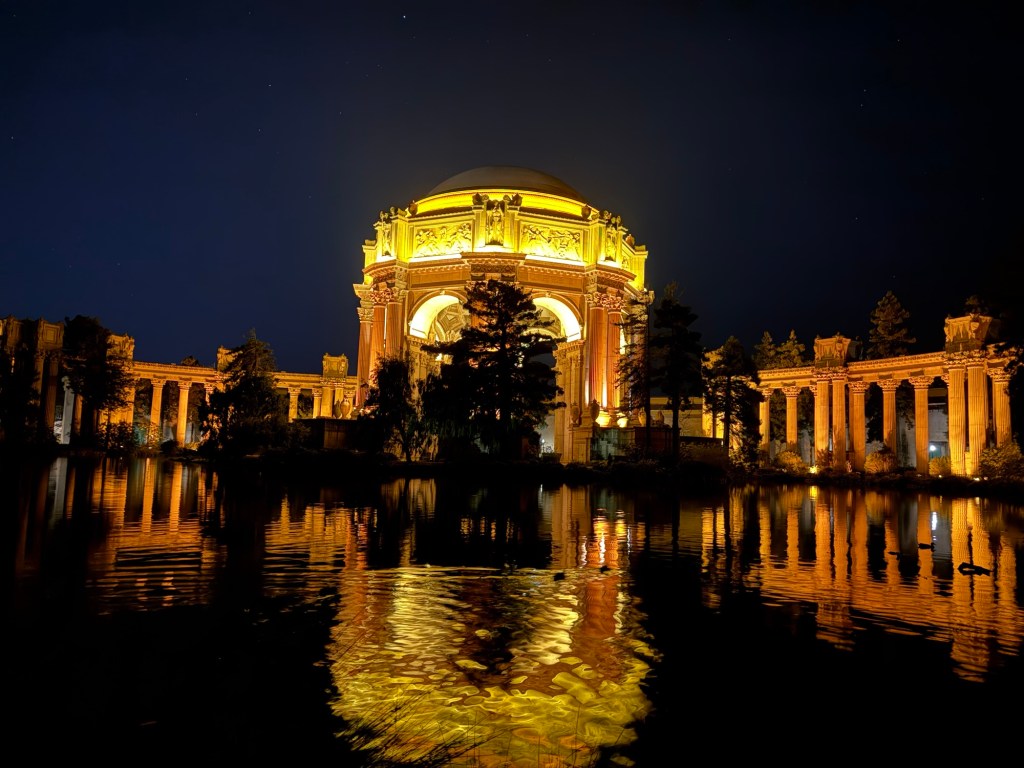
The architect who designed the Palace of Fine Arts wanted it to make you feel something close to sadness. Bernard Maybeck drew his inspiration from Piranesi’s engravings of Roman ruins and from a Symbolist painting of a dark, mysterious island — he wanted visitors to experience a “tranquil melancholy,” a gentle ache at the beauty of things that don’t last.
Standing at the edge of the lagoon last night, the rotunda reflected perfectly in the still water below, I understood what he meant. But the feeling I couldn’t shake wasn’t melancholy at all. It was gratitude — the overwhelming, almost painful kind that comes when you realize you’re exactly where you’re supposed to be.
My oldest son is somewhere on the highway right now, driving cross-country to Michigan with his dad. And my youngest son — had called earlier that week and said, simply, Mom, let me take you out. Let’s spend the day in the city. So we did. And he brought us here, to one of the most breathtaking places in San Francisco, and I will never stop being grateful for that.
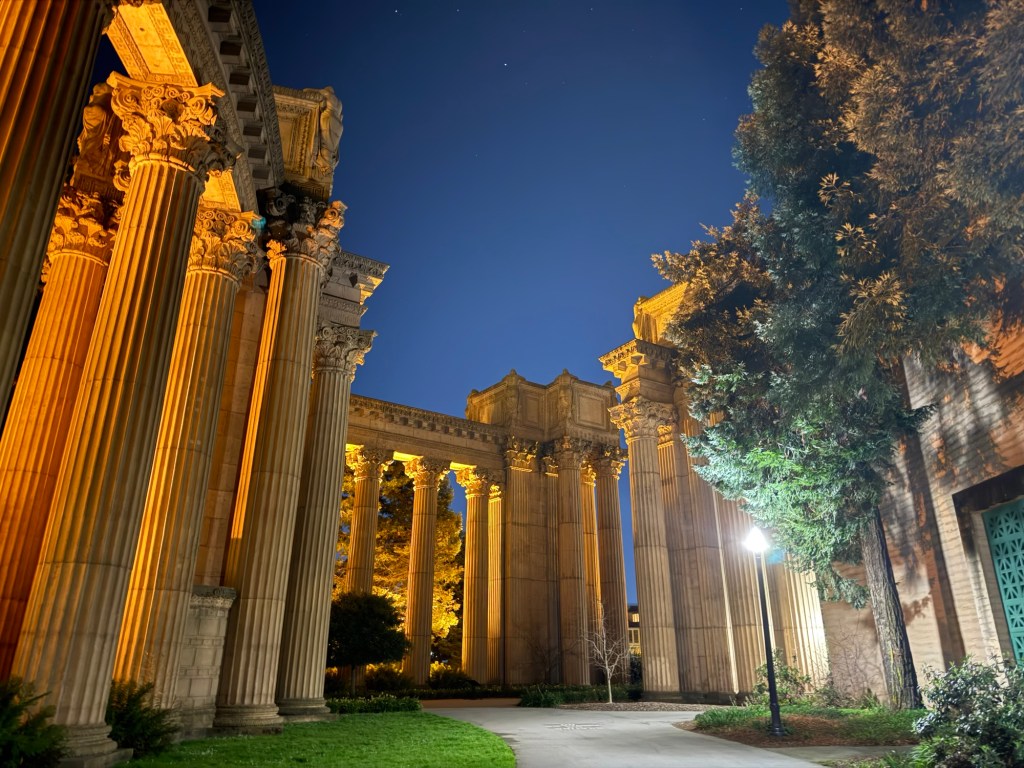
The Story Behind the Structure
The Palace of Fine Arts was born from a moment of civic defiance. In 1915, San Francisco was still pulling itself out of the rubble of the 1906 earthquake and fire. City leaders made an audacious bet: they would host the Panama-Pacific International Exposition — a world’s fair to announce to the globe that San Francisco was back, rebuilt, and ready. In just two hours of fundraising, $4 million was raised, beating out New Orleans and Washington, D.C. for the honor.
At the heart of the exposition stood ten grand exhibition palaces. Most were built to be temporary — plaster over wood, never meant to survive the year. The Palace of Fine Arts was different. Bernard Maybeck, a student of the École des Beaux-Arts, designed the Palace with its soaring colonnade, grand rotunda, and carefully constructed pond, meant to evoke quiet sadness and solemnity. When the fair ended, most of the structures were demolished. But citizens of San Francisco felt the Palace was just too beautiful to destroy.
And so it stayed. Decaying slowly, lovingly saved through decades of public and private effort, until in the 1960s a full reconstruction began, replacing the original temporary materials with permanent concrete. It is the only structure from the 1915 Panama-Pacific International Exposition that survives on site. More than a century later, it is still here — still breathtaking, still drawing people to its edge to stand quietly and feel something.
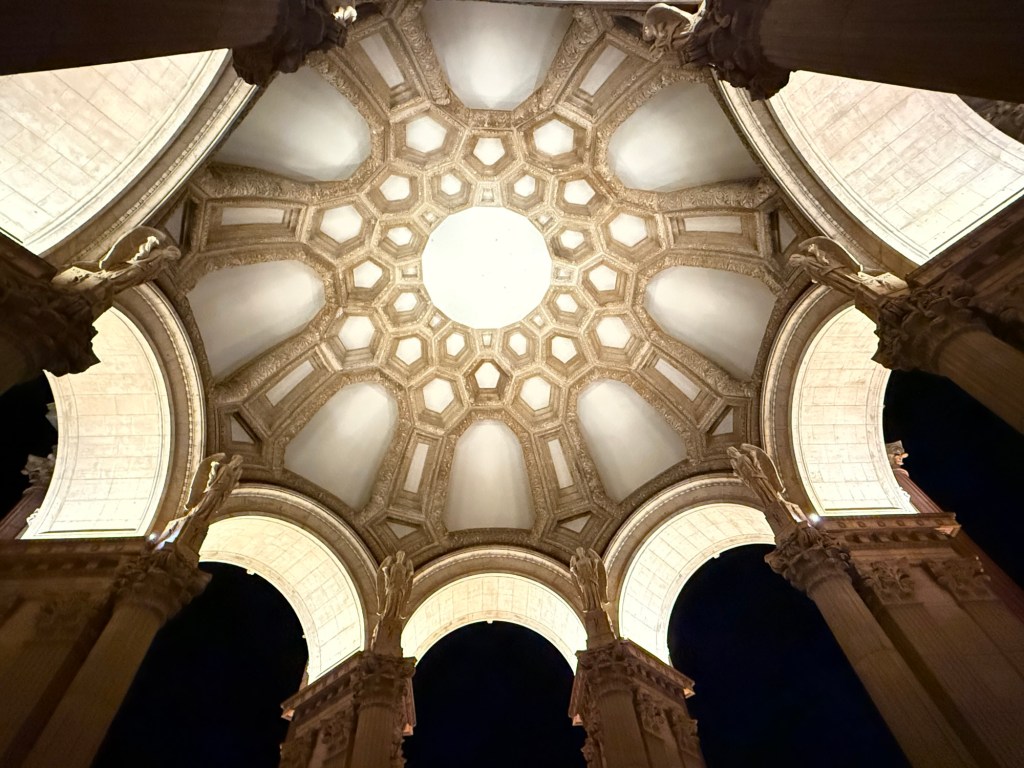
What You See When You Arrive
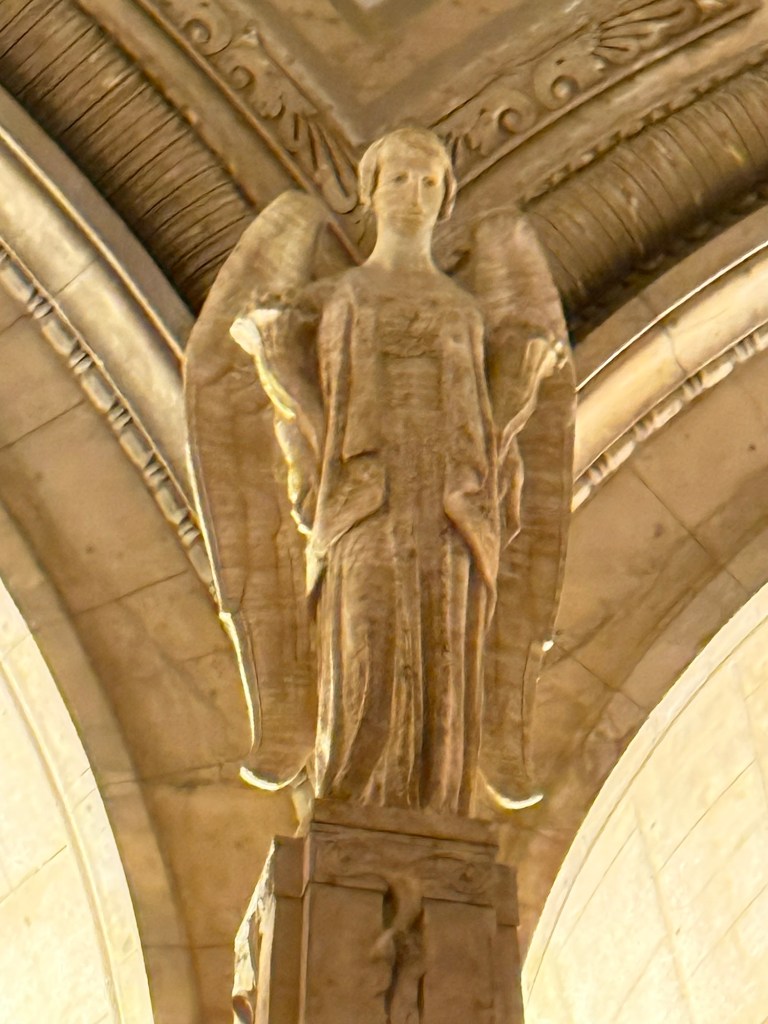
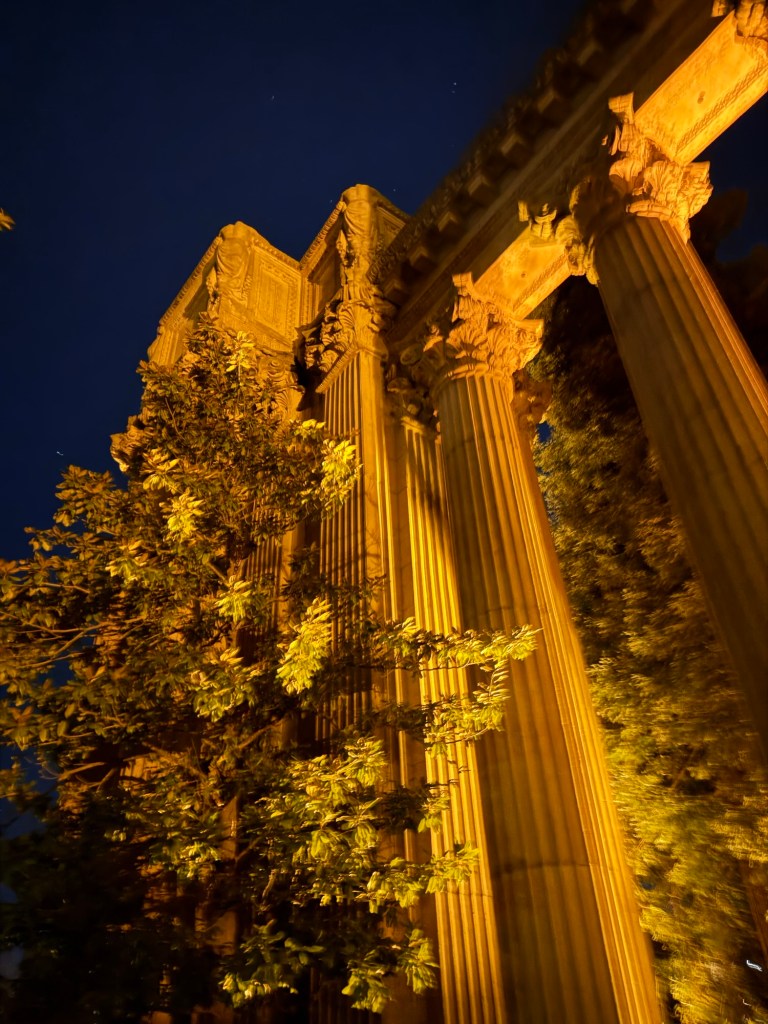
Nothing prepares you for it. You’re driving through the Marina District, passing tree-lined streets and Victorian storefronts, and then suddenly — this. The Corinthian columns, intricate sculptures, arches, and the famous Greco-Roman rotunda rise up before you like something from another century, another world. My daughter actually gasped. My son, who had been there before, just smiled and watched our faces.
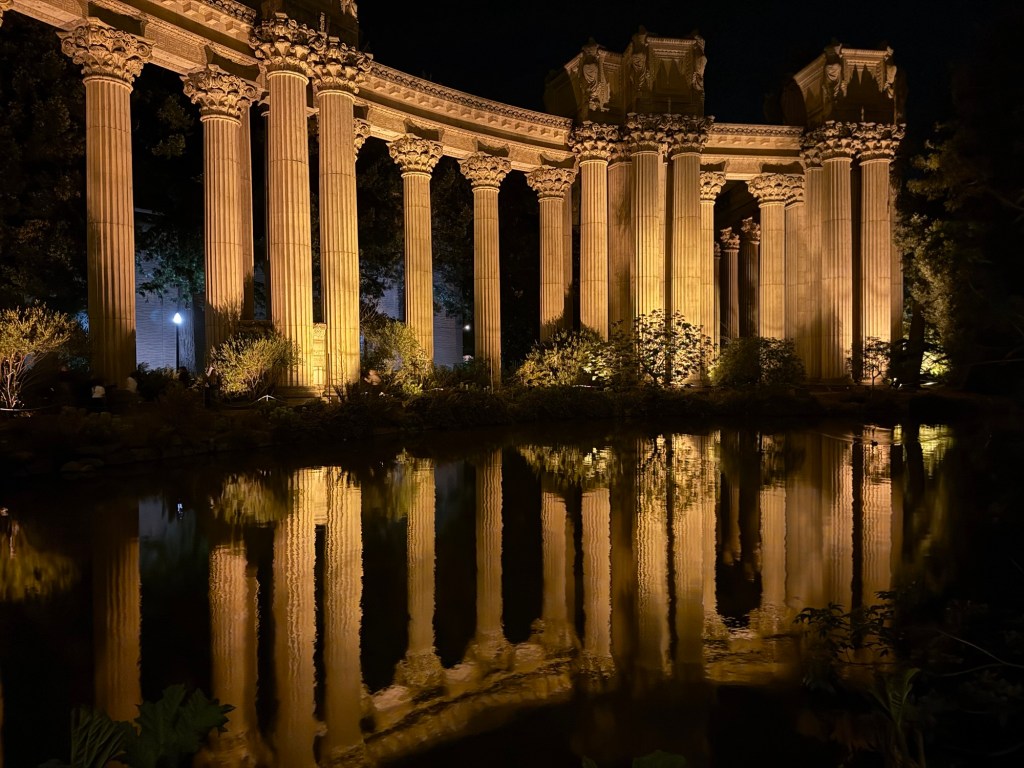
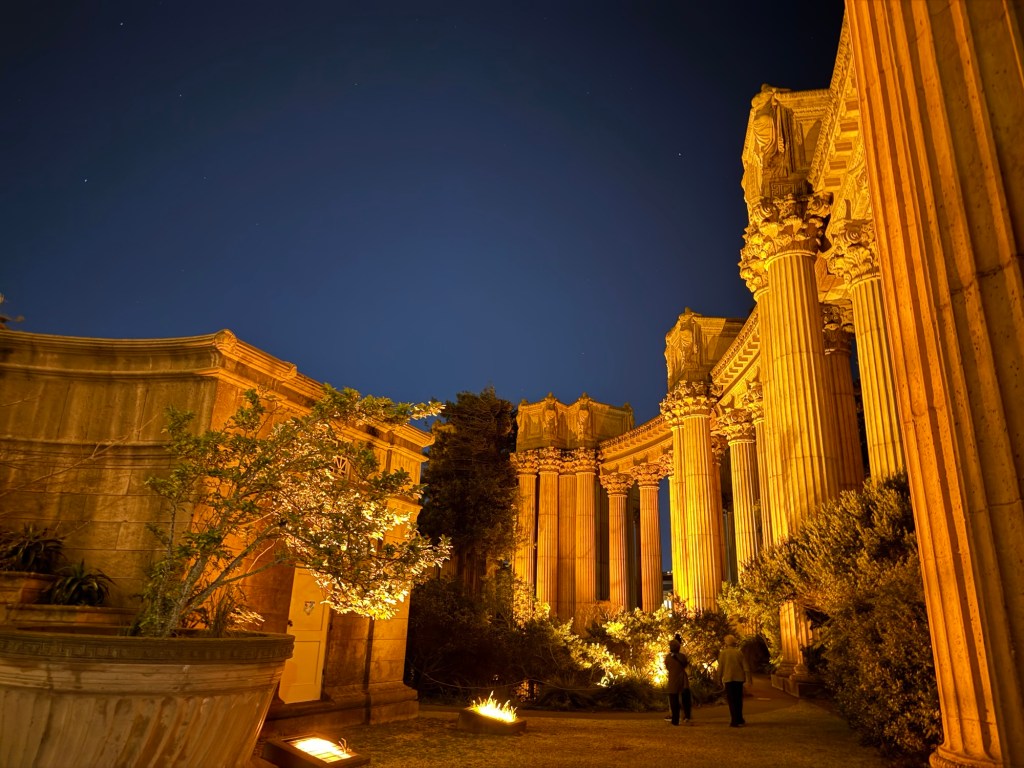
The most prominent building of the complex, a 162-foot-high open rotunda, is enclosed by a lagoon on one side and adjoins a large, curved exhibition center on the other side, separated from the lagoon by colonnades. The reflection in that lagoon is something I won’t easily forget — the rotunda mirrored in dark, still water, the evening sky layering shades of blue behind it. We walked the full length of the colonnade slowly, not saying much. Some things ask for silence.
The grounds are free and open to the public. Swans drift along the lagoon. Redwood trees soften the space between the columns. Families wander the paths; couples sit on benches. It manages to feel both monumental and intimate, which is a rare thing.
VISITING THE PALACE OF FINE ARTS
ADDRESS3301 Lyon St, San Francisco, CA 94123
GROUNDSFree & open daily, 10 AM – 5 PM
NEIGHBORHOODMarina District, near the Presidio
ORIGINALLY BUILT 1915 — for the Panama-Pacific Exposition
ARCHITECTBernard Maybeck
THEATER966-seat venue, opened 1970
PARKING & TRANSITMuni lines 22, 28, 30, 41, 43, 45
BEST TIME TO VISITLate afternoon for golden-hour light on the lagoon
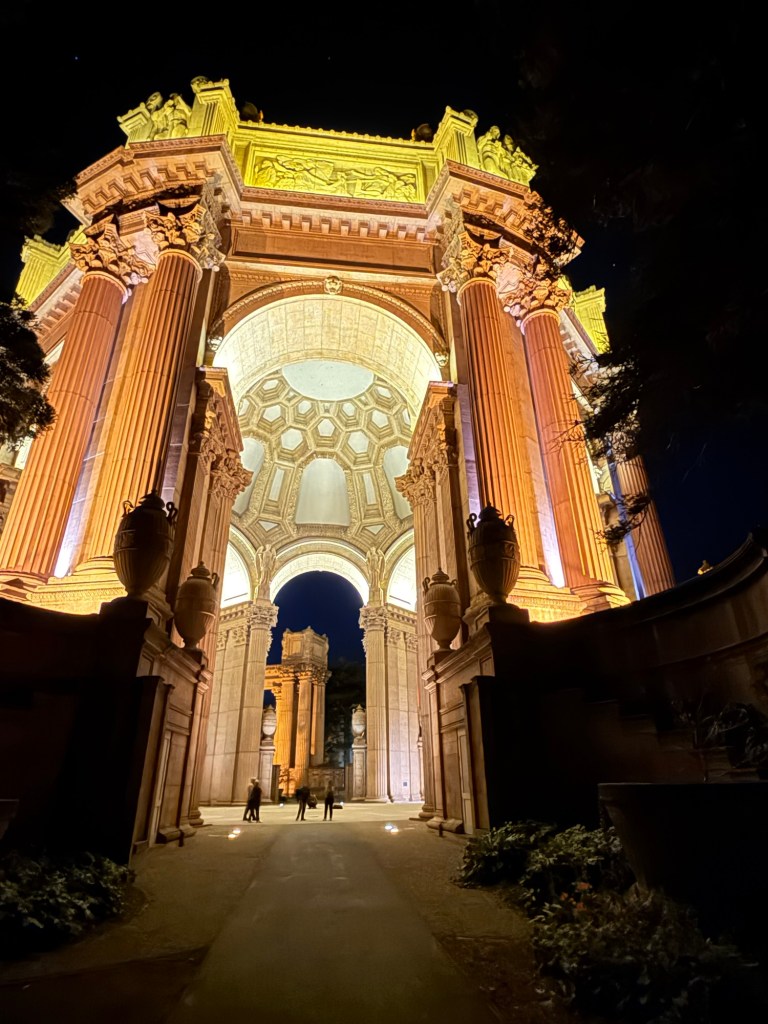
The Palace of Fine Arts Theater
Inside the complex, the Palace of Fine Arts Theatre has been a cultural anchor in San Francisco since 1970. The 966-seat venue has hosted film festivals, live performances, lectures, and community events — including, remarkably, the second presidential debate between Gerald Ford and Jimmy Carter in 1976.
Today the theater continues to host an eclectic mix of performances, screenings, and special events. There’s also an escape room experience — the Palace Games — which runs inside the building and uses the extraordinary backdrop of the architecture as part of the narrative. If you’re visiting with older kids or teens, it’s worth booking in advance. It’s the kind of only-in-San-Francisco experience that’s hard to replicate anywhere else.
The Neighborhood: Marina District & Beyond
The Palace is nestled next to the Presidio, and the other side of the Palace of Fine Arts district sits at the end of a residential neighborhood in the Marina District. The Marina is one of San Francisco’s most beautiful and walkable neighborhoods — broad streets, colorful Edwardian homes, and views of the bay that catch the light differently at every hour. After we left the Palace, we walked toward the water and could see the Golden Gate Bridge in the distance, illuminated against the darkening sky.
The neighborhood rewards wandering. Chestnut Street, a few blocks south, is lined with locally owned restaurants, wine bars, and boutiques. The Wave Organ — a unique acoustic sculpture that uses ocean waves to produce sounds through a series of pipes — is a short stroll away and worth a detour for the curious. And the Presidio, just to the west, offers miles of trails, forest, and bay-view overlooks that could fill an entire day on their own.
We ended the night at a restaurant on the water, the three of us talking and laughing, the kind of easy conversation that only happens with people you love deeply. My son picked up the check before I could reach for my wallet. My daughter leaned her head on my shoulder on the walk back to the car.
The Thing About Being Taken Somewhere Beautiful
When my children were small, I was the architect of our adventures. I planned the trips, packed the bags, decided we were going somewhere new today — because I always believed that showing them the world was one of the deepest forms of love I could offer. Take them to new places. Let them see that beauty is everywhere. Let them become people who notice things.
What I didn’t anticipate was this: that one day, they would do the exact same thing for me. That my son would call on a hard week and say, come on, Mom, let me show you something. That he would bring me to a palace built over a century ago by a man who wanted people to feel moved, and that I would stand there between my two youngest children feeling more moved than I had in months.
Maybeck designed the Palace to evoke the feeling of something that doesn’t last. But some things do. The love between a mother and her children — the particular, specific, irreplaceable love of this family, these kids — that lasts. That’s the thing that endures.
I thought about my oldest somewhere on I-80 East, moving toward his next chapter. I held the ache of that. And then I looked at the rotunda rising above the lagoon, and I looked at my daughter and my son beside me, and I let it all be true at once — the missing and the fullness, the loss and the love. The ruins and the beauty that outlasts them.


 Platnumkitty
Leave a comment