When most people think about visiting the National Archaeological Museum in Athens, they picture the gold death mask of Agamemnon. The bronze statue of Poseidon, arm raised mid-throw. The friezes. The marble gods. The grand, sweeping evidence of one of history’s greatest civilizations.
I saw all of that. And it was breathtaking, every bit of it.
But the pieces that stopped me cold — the ones I’m still thinking about weeks later, sitting here at home with a cup of coffee and a heart that keeps finding its way back to Greece — weren’t the gods or the warriors.
They were the dogs.
A Grave Statue That Stopped Me in My Tracks
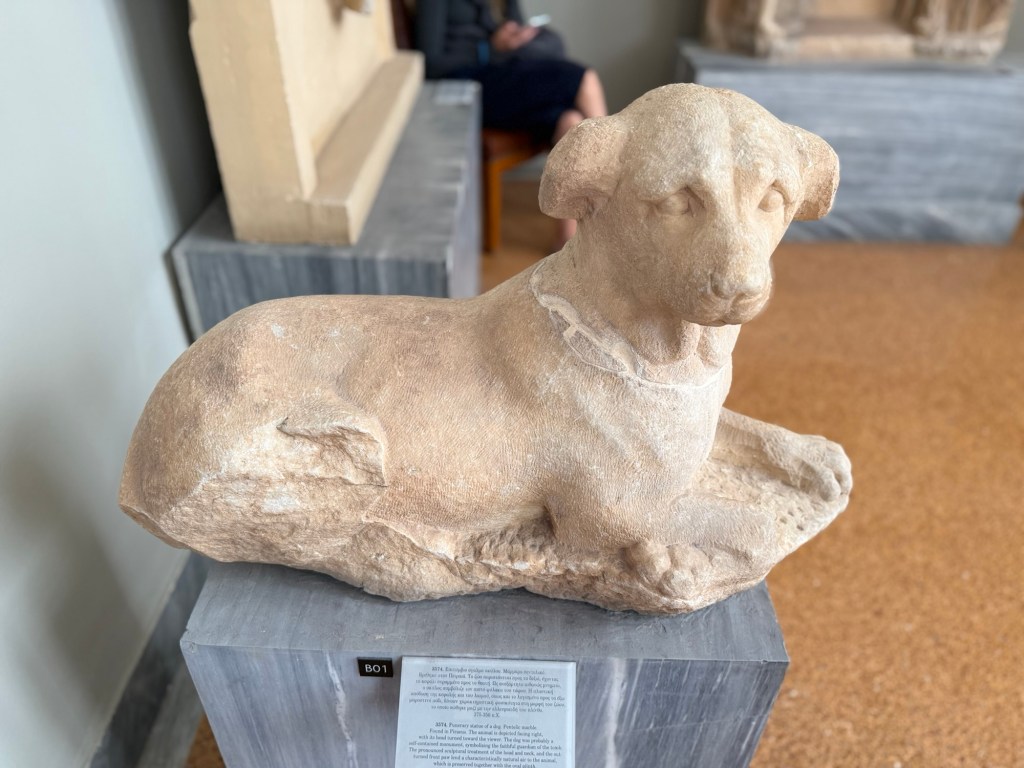
In Room 28 of the museum, near the entrance, there is a marble statue of a dog. Just a dog — sitting, carved in Pentelic marble, dignified and quiet and utterly still. It dates to somewhere between 375 and 350 BC. It was found in Piraeus. And it wasn’t decorative art or mythology. It was a grave monument.
This dog — this beautifully rendered, carefully sculpted dog — was placed at the entrance to the burial enclosure of a prominent Athenian family. Not tucked away. Not an afterthought. Front and center, elevated on a column base surrounded by acanthus leaves and palmettes, flanked by griffins — symbols of immortality — as if to say: this matters. This life mattered.
I stood in front of it for a long time.
I thought about Bayne.
Bayne
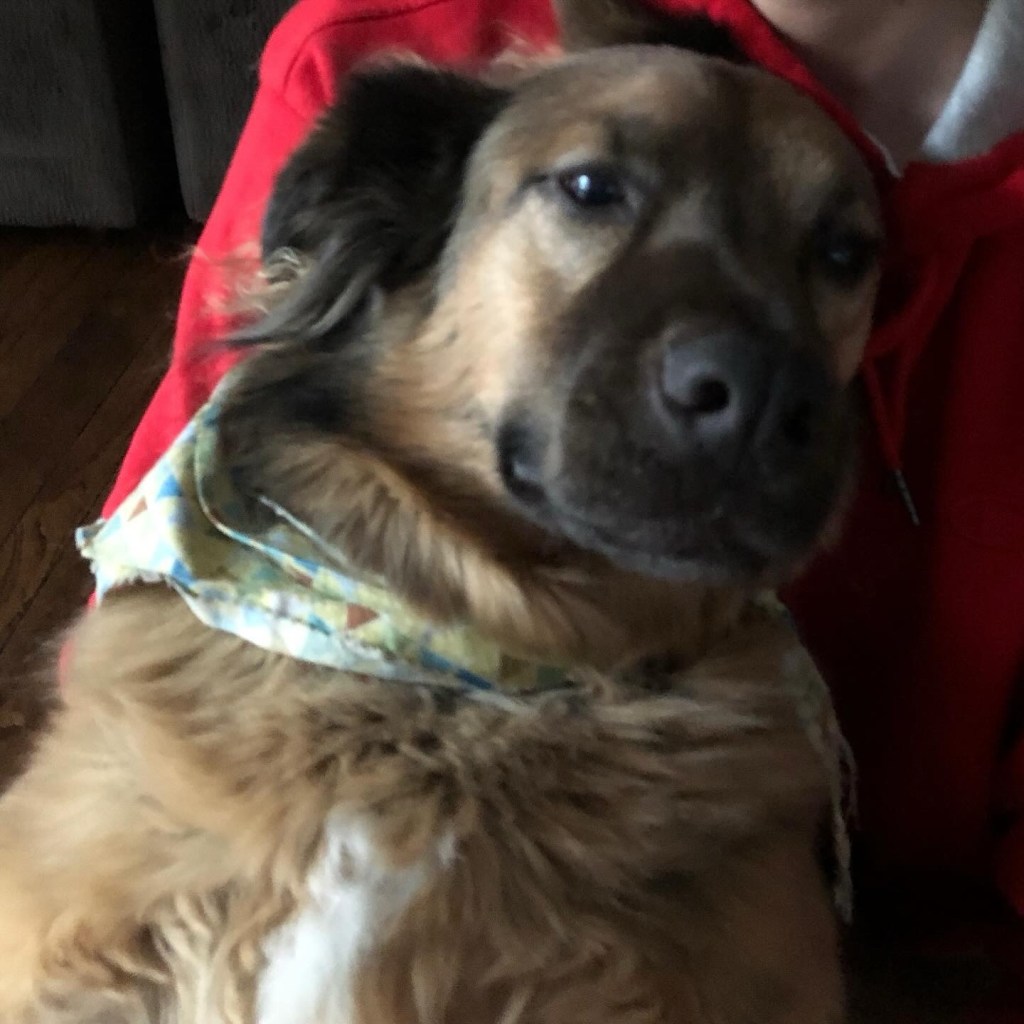
My dog Bayne died almost two years ago. I say “my dog” because that’s the phrase we have, but it doesn’t really capture it. He was family. He was the kind of presence that shapes the rhythm of your daily life so completely that when he was gone, the silence in the house felt like a different kind of sound.
We had him cremated. His ashes sit in a wooden box with a dedication inscribed on it — his name, his dates, the words that felt true. On the box, there’s a lock of his fur and a plaster cast of his paw print. I can’t tell you why the paw print undoes me every time, but it does. Something about the specificity of it. The realness. That exact paw. That particular dog. Not a general loss — this loss.
We did all of this instinctively, the way people do when they’re grief-stricken and reaching for something that will hold the memory. We didn’t think about whether it was rational or proportionate. We just knew that Bayne deserved to be honored. That his life deserved a marker.
Standing in front of that marble dog in Athens, I realized: so did theirs.
The Grave Stelae — Carved Stories of Loss
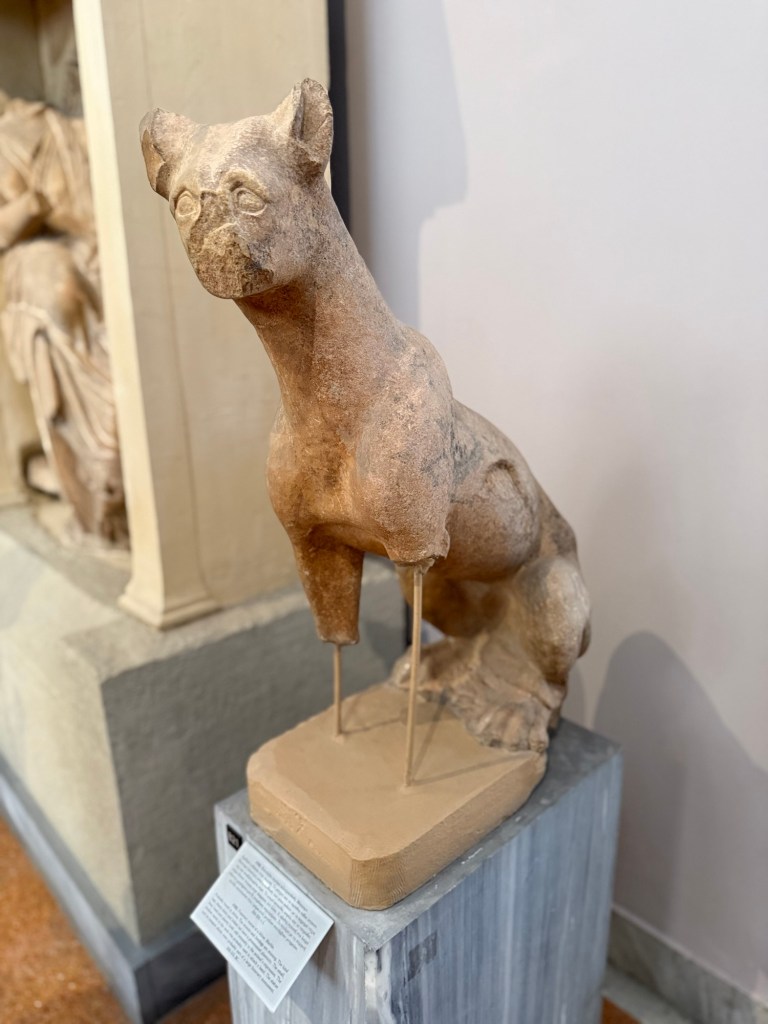
The dog statue wasn’t the only piece that reached out and grabbed me. Across the museum, in various rooms, there are grave stelae — carved stone panels that once stood at the entrances of family burial plots — and several of them feature dogs.
One of the most moving depicts a young man, a nude youth leaning against a pillar with his legs crossed, with a dog beside him. The dog isn’t incidental. He’s characterization. He’s the artist saying: this is who this person was. He loved his dog. His dog was part of him. The stele is attributed to the Parian sculptor Skopas, or his workshop — so this wasn’t a small commission by a grieving family with modest means. This was fine art. The dog earned his place in fine art.
There’s another — Grave Stele 742 — depicting a young athlete, a strigil in hand, and a dog at the bottom of the frame. The inscription at the top reads simply: “Greetings, Agathokles.” A hello across 2,400 years. And the dog is right there with him, like he always was.
And then there’s one that I find almost unbearably tender: a stele of a young man saying farewell to his father — the classic Greek handshake of departure — with his dog at his side. Father, son, dog. A whole family, frozen in marble. Saying goodbye.
The Words They Left Behind
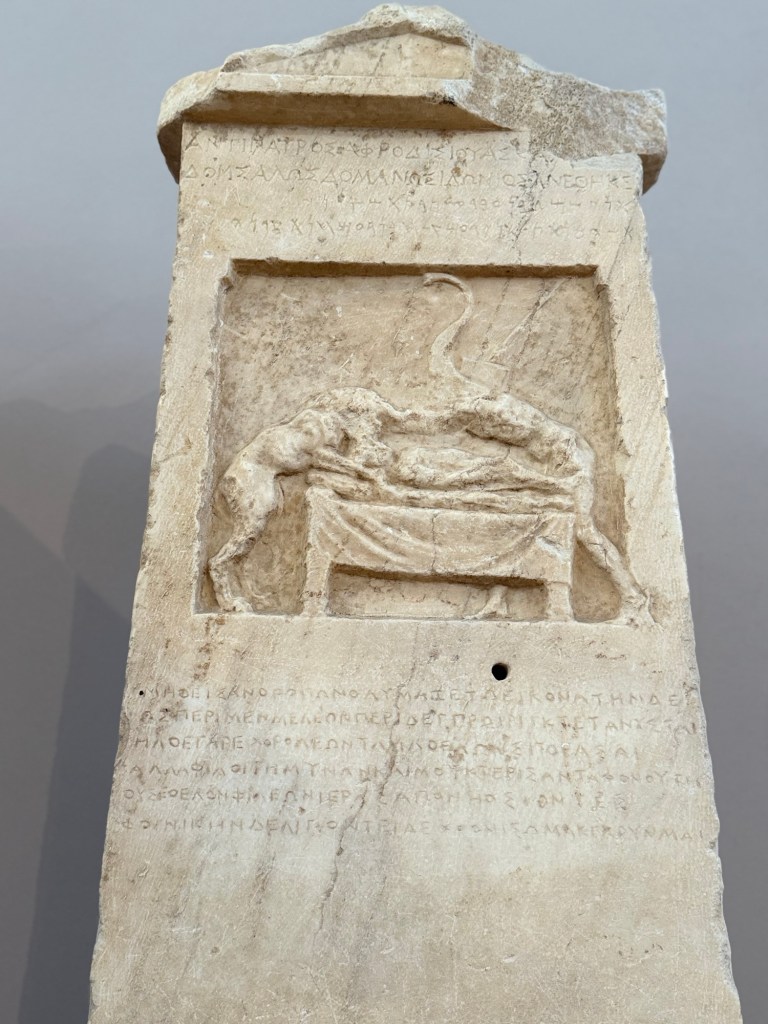
If the sculpture moved me, the epitaphs wrecked me. Because the ancient Greeks didn’t just carve their animals into stone — they wrote to them. About them. For them. And the words are so raw, so recognizable, that they don’t feel like artifacts at all.
There was a woman named Rhodope who wrote her dog’s epitaph in the dog’s own voice, so that whoever passed the grave would understand: “This is the tomb of the dog, Stephanos, who perished, whom Rhodope shed tears for and buried like a human.”
She buried him like a human. In 340 BC. And she wanted the world to know it.
Another inscription, written by a grieving owner to a dog named Patricus, reads in part: “So, Patricus, never again shall you give me a thousand kisses. Never can you be contentedly in my lap. In sadness I buried you as you deserve. In a resting place of marble, I have put you for all time.” A thousand kisses. Contentedly in my lap. This person knew the particular weight of a dog in your lap. They missed it the way I miss things about Bayne. The specific, physical, irreplaceable things.
And then there’s the shortest one. The one that hit me like a quiet wave and wouldn’t let go: “Myia never barked without reason, but now he is silent.”
That’s it. That’s the whole epitaph. And somehow it says everything.
One more — and this one is so achingly human it could have been written yesterday: “You who pass on this path, if you happen to see this monument, laugh not, I pray, though it is a dog’s grave.”
They knew people might judge them. They knew society might raise an eyebrow at a marble monument for a dog. And they put it there anyway, and they asked passersby not to mock it, and they meant every word. That defensiveness, that quiet insistence that this grief was real and valid — I know that feeling. Every pet owner knows that feeling. The slight hesitation before you tell someone how hard you took your dog’s death, because you’re not sure they’ll understand.
The ancient Greeks understood.
A Sarcophagus in Storage for 81 Years
Here’s a detail that I love, and that feels like its own small story about how the world works. Somewhere in the museum’s collection — unearthed in 1937 near what is now the National Garden — there is a small sarcophagus with a dog sculpted on the lid. He sits with his front legs crossed, dignified, resting on what appears to be a striped cushion, like he’s simply taking a nap. It dates to the mid-3rd century AD.
It sat in museum storage for 81 years before it was put on display.
81 years. And then one day, someone decided the world should see it, and museum archaeologists began organizing tours centered on the ancient Athenians’ relationships with their animals. As if the museum itself finally recognized that this was part of the story too — not a footnote, not a curiosity, but a genuine and important expression of who these people were.
I like to think that little dog on his cushion had been waiting patiently all that time.
The Thread That Runs Through Everything
This is the thing that kept washing over me in that museum, and that has stayed with me since I came home: the timeline.
The cats of Athens today — the ones sleeping in doorways and eating from bowls set out by neighborhood residents — they are part of a tradition of care that stretches back over two and a half millennia. The hotel owner in Mykonos who told us Frederico was family. The Santorini hotel staff who welcomed Sonia and her kind because they were part of the household. The tourists kneeling down on mountain roads to scratch a dog behind the ears.
It’s all the same impulse. It has always been the same impulse.
We talk about the ancient Greeks as if they were distant and foreign — people of myth and marble and a world we can barely imagine. But walk through Room 28 of that museum, stop in front of that dog carved in Pentelic marble, and read the words Rhodope left for Stephanos, and you realize: they were us. They sat with their dogs in the sun. They let them put their heads in their laps. They were devastated when they died. They wanted the world to know that this small life had mattered.
My Bayne is in a wooden box on a shelf, with his fur and his paw print and his name. Stephanos is in a marble tomb in Piraeus. Patricus has his epitaph. Myia — who never barked without reason — has her line of poetry.
We have always done this. We have always needed to do this. Because loving an animal fully means acknowledging that they are real, and present, and irreplaceable — and that when they go, something specific and unrepeatable goes with them.
The ancient Greeks knew it.
We know it.
Some things, thankfully, do not change.
If you lost a pet and have your own way of honoring their memory, I’d love to hear about it in the comments. These stories matter, and so did they.


 Platnumkitty
Leave a comment