Part 1 of The Geology of Ideas series.
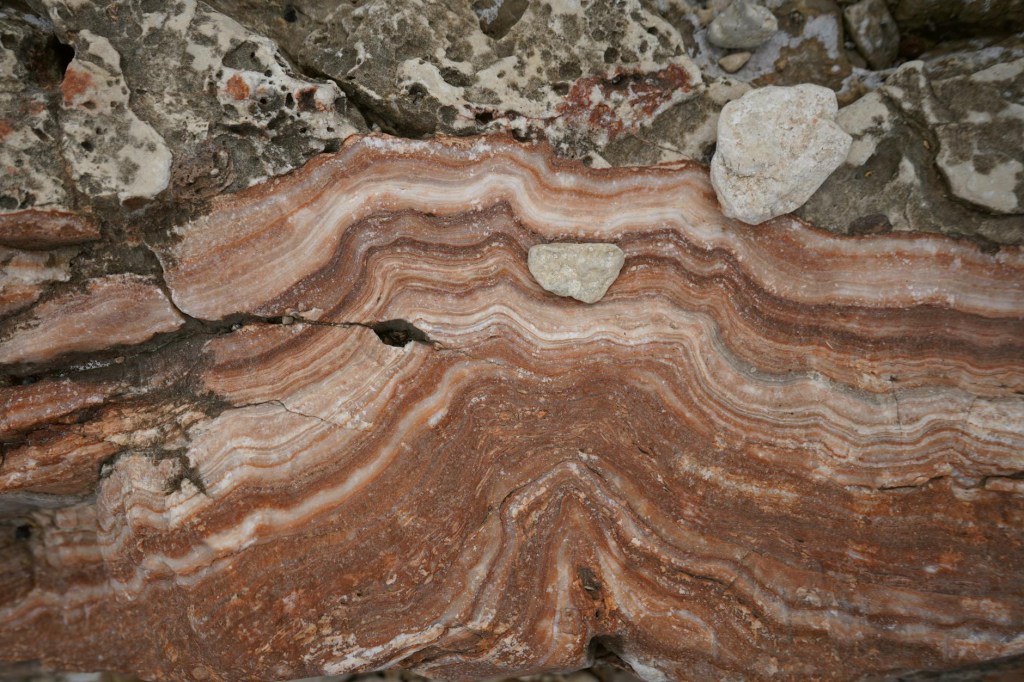
Let me ask you something a little weird: when was the last time you felt genuinely, effortlessly creative?
Not “staring at a blank screen waiting for inspiration to strike” creative. Not “I’ve had three coffees and I’m going to power through this” creative. I mean the kind where ideas just — arrive. Where you’re in the flow of something real, and the work feels less like output and more like excavation.
If you can’t remember the last time that happened, you’re not broken. You’re not behind. You might just be working on the wrong layer.
Here’s what I mean.
Your Mental Topsoil vs. The Bedrock Beneath You
Think about how soil actually works. On the surface, you’ve got topsoil — the layer that interacts with everything. It picks up debris. It shifts with weather and wind. Things grow there, but it’s also where things decay, get disturbed, and wash away.
Your mental topsoil? That’s your daily noise. The to-do lists. The unread emails. The fifteen browser tabs. The mental loop of did I respond to that, what are we having for dinner, wait what day is it. It’s not bad — you need topsoil. Things grow there. But it’s reactive. Fragile. Easily disturbed.
Go deeper, and you hit bedrock.
Bedrock is the geological layer that doesn’t move. It’s ancient, compressed, solid. In your creative life, your bedrock is the core material you keep returning to without realizing it. The theme that shows up in everything you make. The question you’ve been quietly asking your whole life. The tension you can’t seem to resolve — and probably shouldn’t, because it’s the engine of everything interesting about you.
For me, it’s always been the push-pull between adventure and belonging. I want to be somewhere new and untouched — standing at the edge of Santorini’s caldera, or hiking up into the rice terraces of Bontoc in the Philippines — and I simultaneously want to be home, rooted, surrounded by the people I love most. That tension is in every piece I write, whether I’m consciously putting it there or not.
How to find YOUR bedrock:
• Look at your last 10 pieces of content or writing. What theme do they all share? (Even if you never intended it.)
• Ask yourself: What question do I find myself asking over and over again, in different forms, in different seasons of life?
• Notice what makes you viscerally angry or deeply moved. Those reactions are geological — they come from somewhere deep.
• Try this journaling prompt: “If I had to write about one thing for the rest of my life, and it had to matter to me personally, it would be…”
Your bedrock doesn’t change much. That’s the whole point of it. And once you know what it is, you stop chasing ideas and start going deeper into the one that was always yours.
The Erosion of Distraction: How the Surface Gets Stripped Away
Here’s the part nobody wants to hear: we are actively eroding our own creative ground. Every day.
In geology, erosion happens when wind, water, or repeated friction wears away the surface layer. What’s left is either bare rock — which looks dramatic but can’t grow anything — or a thin, unstable layer that can’t hold seeds. The creative equivalent of erosion is constant input without any space for output or integration.
Think about your average morning. Before your feet hit the floor, how many of you have already checked your phone? You’ve absorbed notifications, skimmed someone’s highlight reel, half-read a news headline, and watched a fifteen-second video of someone else’s creative work. And your brain — which was literally processing, sorting, and generating ideas while you slept — just got interrupted before it had the chance to hand them to you.
I don’t say that to shame anyone. I’ve done it. I still do it. But I’ve started to notice that the mornings I grab my phone first are the mornings I feel the most scattered by noon. And the mornings I sit with a cup of coffee and literally just… exist for twenty minutes? Those are the mornings the good stuff surfaces.
Distraction isn’t always the dramatic kind. Sometimes erosion is slow. It looks like:
• Always having a podcast playing when you drive or walk
• Filling every quiet moment with scrolling
• Consuming SO much of other people’s work that your own voice gets drowned out
• Being ‘productive’ in ways that feel safe and busy but never cost you anything creatively
Anti-erosion practices to try:
• Give yourself a 30-minute phone-free morning window. Just once. See what surfaces.
• Drive somewhere without music or podcasts. Let your brain catch up with itself.
• When you feel the urge to scroll, pause and ask: “Am I filling space or am I actually curious about something?”
• Create a “notice and capture” habit: Keep a small notebook or voice memo habit for whatever bubbles up in quiet moments. Ideas are shy. They show up when it’s safe.
Fertile creative ground needs fallow time. Farmers know this. Soil that gets worked constantly, without rest, without cover crops, without space to replenish — eventually it gives you nothing. Your mind works the same way.
The Creative Water Table: It’s Never Actually Gone
This is my favorite part. And it’s the part that I wish someone had told me years ago during the seasons when I felt completely empty.
A water table is the underground zone where the ground is completely saturated with water. It doesn’t depend on rainfall to exist — it’s just there, deep and constant, fed by sources that have nothing to do with what’s happening on the surface. When there’s a drought, the surface cracks. Things wither. It looks dead. But drill down far enough, and you’ll hit water.
Your creative water table works the same way.
The dry spells aren’t proof that you’ve lost your creativity. They’re proof that you haven’t drilled deep enough lately — or that the surface conditions have made it hard to access what’s already there. The source itself? Still running. It always is.
I’ve had seasons where I felt completely wrung out creatively. One particular stretch comes to mind — I was busy, overstimulated, running on obligation and output, and I genuinely thought: maybe I just don’t have anything interesting left to say. And then I took a long solo drive to nowhere in particular. No music. Just road and sky. And by the time I pulled back into my driveway, I had three ideas I couldn’t write down fast enough.
The well wasn’t dry. I had just stopped digging.
How to drill down to your water table:
• Change your physical context. Go somewhere you’ve never been, even if it’s a neighborhood two miles away. New environments reset perception and loosen stuck thinking.
• Return to what made you fall in love with creating in the first place. Re-read the first thing that made you feel like writing mattered. Revisit the music, the book, the trip that cracked you open.
• Give your hands something to do. Cooking, gardening, drawing doodles, organizing a drawer — repetitive physical tasks free up the background processing where real ideas live.
• Free-write with zero stakes. Set a timer for 10 minutes. Write the most honest, unfiltered, nobody-will-ever-read-this version of what’s actually on your mind. This isn’t content. This is drilling.
• Ask the deeper question. Instead of “What should I write about?” try: “What have I been avoiding thinking about?” or “What’s something I know to be true that I’ve never said out loud?” That’s where the water is.
The Big Picture: You’re Not Blocked. You’re Just Surface-Level.
Here’s what I want you to take from all of this:
Creative blocks are almost never actually blocks. They’re signals. They’re the surface of the earth telling you it’s been over-worked, under-nourished, and under-rested. They’re your mind redirecting you from the topsoil chaos down toward the bedrock material that actually matters to you. They’re the drought that proves the water table is there — you just need a different kind of access.
When you feel creatively depleted, instead of pushing harder on the surface level, try going down. Get quiet. Find your bedrock theme. Reduce the erosion. And trust that the water is there, waiting, exactly where it’s always been.
Because it is. I promise you it is.


 Platnumkitty
Leave a comment