Part 2 of The Geology of Ideas series. If you missed Part 1 on stratifying your creative layers — your mental topsoil, bedrock, and water table — you might want to start there. But honestly? This one can stand on its own.
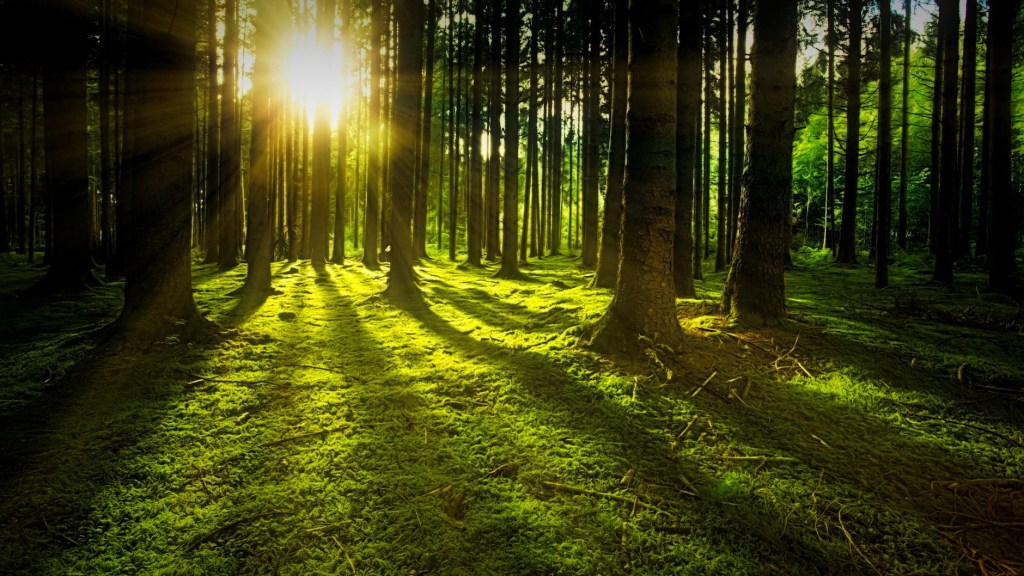
There’s a tree outside my window that I have looked at approximately ten thousand times.
I know this because I’ve lived here long enough to watch it through every season. I know its shape. I know it’s there. I have, by any normal measure, “seen” that tree countless times.
But last fall, I actually looked at it for the first time.
I mean really looked. Sat still long enough to notice the way two of its branches had grown into each other over the years, bark fusing, the boundary between them almost invisible. Long enough to see the three different species of lichen on its north-facing side — one silver-gray, one almost orange, one the pale green of old sea glass. Long enough to watch a single leaf detach, not dramatically, but in this slow, inevitable spiral, like it had simply finished.
And I thought: how many things have I been seeing without ever actually looking?
That question is what this whole post is about. Because I think it might be the most important question a creative person can ask.
First, a Quick Science Lesson (Bear With Me)
Photosynthesis, in its simplest form, is the process by which plants convert light into food. Sunlight hits a leaf. The leaf captures it. Through a series of reactions that still kind of blow my mind, that light energy gets transformed into glucose — actual fuel the plant can use to grow, bloom, seed, and survive.
But here’s the part that’s easy to miss: plants don’t just passively receive sunlight. They orient toward it. Their leaves are shaped to maximize capture. The chlorophyll in their cells is specifically designed to absorb certain wavelengths and convert them, not just absorb them. The whole system is built for transformation, not just intake.
Now tell me that doesn’t sound exactly like what the best creative work requires.
Observation is your sunlight. Attention is your leaf. And your unique creative process — your perspective, your voice, your way of making meaning — is the chlorophyll. The thing that actually does the converting.
The Art of Deep Notice: Beyond the ‘Pretty View’
We are a species that has gotten very good at glancing.
We travel somewhere breathtaking, hold up our phones, capture the panorama, and move on. We call this experiencing the place. But a photograph of a view and the experience of actually sitting inside it are not the same thing, and I think some part of us knows that.
Deep notice is different from appreciation. Appreciation says: this is beautiful. Deep notice asks: what exactly is happening here? It gets small. It gets specific. It stays.
I think about the rice terraces of Bontoc in the Mountain Province of the Philippines — these ancient, stepped fields carved into the mountainside by hand, over generations. A glancing eye sees: wow, incredible, green, dramatic. But if you slow down, you start to notice the sound of the water channels running between the paddies. The way the terraces are slightly uneven because they follow the mountain’s natural contour, not a grid. The fact that some sections are newer, their walls not yet covered in the same moss as the ancient ones. The woman in a faded pink shirt who’s been working the same fifty-foot strip all morning while tourists like me stand at the overlook taking photos.
That’s the stuff. The small, specific, human, textured stuff. That’s what actually becomes writing. Not the panorama — the woman in the pink shirt.
Practicing deep notice looks like:
• Studying decay, not just bloom. A single dying leaf tells you more about a tree’s life than a whole canopy of perfect green ones. Where is it splitting? What color is it going? What’s still clinging to it?
• Naming what you see with specificity. Not “a bird” but “a small brown bird with a rust-colored tail that keeps landing on the same branch.” Not “a nice smell” but “something between rain and cedar and something I can’t name but it’s from childhood.”
• Noticing pattern and interruption. The lichen on a rock follows a pattern until it doesn’t — and the interruption is always interesting. Where does the expected break? That break is a story.
• Slowing down to animal speed. Watch a snail actually cross something. Track a single ant back to its colony. This is not a waste of time. This is recalibrating your sense of scale, which is one of the most useful things a writer can do.
• Using all five senses, not just your eyes. What does this place sound like with your eyes closed? What does it smell like when the wind changes? What does the bark feel like under your fingers?
The writer Annie Dillard built an entire book — an entire worldview — from sitting at a creek and paying deep attention. You don’t need Tinker Creek. You need ten minutes and the willingness to actually look.
Input as Sunlight: Curating What You Consume
Here’s something worth sitting with: plants can’t photosynthesize in the dark. If you block the light source, it doesn’t matter how good the chlorophyll is. Nothing gets converted. Nothing gets made.
What’s your light source?
I’m asking about what you actually consume — visually, audibly, experientially — on a regular basis. Not what you think you should be consuming. What you’re actually taking in, day after day, and feeding to your creative process.
Because here’s the honest truth: not all light is the same. Some wavelengths of light are exactly what chlorophyll needs; others pass right through without doing anything. And some inputs are genuinely nourishing for your creative output, while others just… occupy space in your brain without ever transforming into anything.
I’m not here to tell you that social media is bad and literary journals are good. That’s too simple, and also kind of boring. The real question is: does what you’re consuming make you want to make things, or does it make you feel like you should have made things by now?
There’s a difference between input that ignites and input that deflates. And once you start noticing the difference, you can’t un-notice it.
A curation audit — honest questions to ask yourself:
• After consuming this (show, account, podcast, song, book), do I feel energized or depleted? Do I want to create something, or do I want to disappear?
• Am I consuming work by people whose perspective genuinely challenges or expands mine, or am I staying in a comfortable echo chamber of the same aesthetic, the same voice, the same worldview?
• What’s the ratio of consuming to making in my average week? Is it sustainable for the kind of creative I want to be?
• Is there something I’ve been meaning to read/watch/listen to — something that actually excites me — that I keep pushing aside for easier input? Why?
Some inputs that tend to act as high-quality creative sunlight:
• Things made with obvious love and specificity — a documentary about one very niche thing, a book that goes deep on one small subject, an account run by someone genuinely obsessed with their craft
• Work in a different medium than your own. If you write, watch more films. If you make visual content, read more poetry. Cross-pollination is where unexpected ideas live.
• The texture of real life: markets, streets, strangers’ conversations, architecture you’ve never noticed, the way light hits a particular surface at a particular time of day
• Silence and unstructured time, which technically isn’t input — but functions like sunlight breaking through cloud cover
You are, in a very literal creative sense, what you consume. Not because consuming shapes your opinions (though it does), but because it shapes what raw material your creative process has to work with. Feed it junk light, get junk output. Feed it real, rich, specific, challenging light — and watch what your chlorophyll does with it.
Your Chlorophyll Equivalent: The Process That’s Uniquely Yours
This is the part most creative advice skips entirely. And it might be the most important part.
Every plant has chlorophyll, but not every plant processes light the same way. A fern and a cactus are both doing photosynthesis — but their systems, their structures, their timelines, and their outputs are radically different. The fern needs deep shade and humidity. The cactus needs brutal direct sun and can go months between drinks. They’re both thriving. They’re just not doing it the same way.
So: are you a fern, or are you a cactus? And have you been trying to grow in the wrong conditions because you thought you were supposed to be the other one?
Your chlorophyll equivalent is your unique transformation process — the specific way you take raw observation and experience and convert it into creative output. It’s not the same as anyone else’s, even if you work in the same medium, cover the same topics, and grew up in the same city. It’s yours.
Some people need to let things steep for months before they can write about them. Others need to process in real time, almost journalistically, while the feeling is still raw. Some people need to talk it out first — to tell the story out loud before they can write it. Others need total silence and solitude or nothing coherent emerges at all. Some creatives are sparked by constraint; others wither under it. Some need structure; others need to meander.
None of these is the right way. All of them are the right way for the person whose system they are.
To figure out your own chlorophyll, reflect on:
• Think about the last thing you made that you were genuinely proud of. What conditions led to it? What were you doing in the days before it came together? What did your process actually look like — not the idealized version, the real one?
• How long does your creative lag tend to be? From experience to output, do you need hours, days, months, or years? There’s no wrong answer, but knowing your own rhythm stops you from panicking when things feel slow.
• What medium or format do you instinctively reach for when something moves you? That instinct is data. Don’t override it.
• When do your best ideas actually come? In the shower, on walks, just before sleep, mid-conversation with a specific person, staring out the window of a moving vehicle? Start engineering more of those conditions.
• What’s your relationship with the first draft? Do you write cold and revise into warmth, or do you need to feel your way in slowly before anything honest appears? Your answer should determine how you structure your process — not how someone else’s process works.
A lot of creative frustration comes not from a lack of talent or ideas but from using someone else’s process. You’re a fern trying to grow in full desert sun because the cactus next to you is thriving. Figure out your conditions. Build your conditions. Protect them.
The 45-5 Sit Spot: This Week’s Actionable Practice
Okay. Here’s where we get practical. And I want to be honest: this exercise sounds almost too simple. You might read it and think, that’s it? But I’m asking you to trust the simplicity, because what it produces is anything but simple.
The Practice:
Find a spot outside. It doesn’t have to be beautiful or remote or dramatic. Your backyard, a park bench, a patch of sidewalk with a tree growing out of it. Somewhere with something alive in it, even if that’s just a weed pushing through concrete.
Sit there for 45 minutes. Do nothing else.
No phone. No notebook yet — the notebook comes later. No podcast. No planning your grocery list. Just sit. Watch. Listen. Smell the air. Let your eyes go where they want. Let your attention drift and settle and drift again.
For the last 5 minutes, take out something to write on and write down everything you sensory-noticed. Not poetry. Not narrative. Not “it made me think about my childhood.” Data.
What ‘data’ looks like:
• The bark on the third tree from the left is darker on the north side and has three vertical splits.
• A car alarm went off twice in the distance. Both times, birds went quiet for about four seconds.
• The air smells different when the wind shifts to the east — something slightly organic, like turned earth.
• I noticed a red leaf that had landed face-down in a puddle and been there long enough to leave a faint red tint in the water.
• There’s a crack in the sidewalk that runs almost perfectly straight for about eight inches, then angles sharply left, then stops.
See? Not pretty writing. Not processed writing. Just raw, specific, sensory observation. The kind that you can actually build something from later.
Why it works:
The 45 minutes of doing nothing is actually doing everything. It’s recalibrating your nervous system to a slower, more attentive pace. The first ten minutes, your brain will resist. It’ll want to scroll, to plan, to problem-solve. Let it. By minute twenty, something shifts. By minute forty, you’re seeing things you would never have caught in a glance.
The 5-minute data dump is the conversion. It trains you to translate observation into language — fast, specific, unfiltered. It’s the chlorophyll doing its work. You’re not writing a post. You’re not crafting anything. You’re just making the raw material available to yourself.
And then, later — maybe the next day, maybe a week from now — you’ll be in the middle of something completely unrelated and one of those data points will suddenly click into a metaphor, an image, an opening line, a whole piece you didn’t know you had in you.
That’s photosynthesis. That’s light becoming food.
The Bigger Invitation
We live in a world that rewards speed and volume. More content, more output, more ideas, faster. And somewhere in that pressure, we forget that creativity is fundamentally a biological process. It needs raw material. It needs the right conditions. It needs time to convert.
You are not a content machine. You are an organism. And organisms don’t produce endlessly from nothing — they convert what they take in, through processes that are slow and invisible until suddenly they’re not.
So this week: sit somewhere. Be still long enough to actually see. Curate your light source. Trust your own process for transformation, even if it doesn’t look like anyone else’s.
And know that the leaf you’re watching decay? The lichen pattern nobody else stopped to name? The snail crossing a twelve-inch stretch of bark in fifteen minutes of complete indifference to your deadlines?
That’s your sunlight. Don’t waste it.

 Platnumkitty
Leave a comment