Part 3 of The Geology of Ideas series.
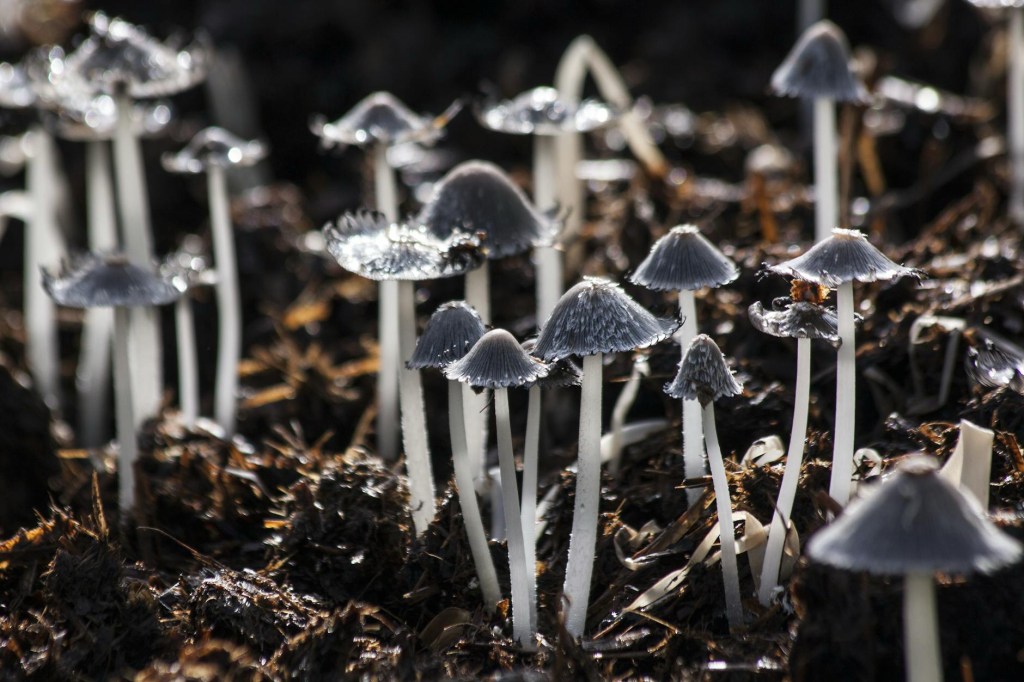
We’ve dug into your creative bedrock and learned to convert observation into fuel. Now we’re going underground in a whole new way — into the network that’s been quietly connecting everything all along.
I want to tell you about fungi, because fungi are going to change how you think about everything you’ve ever dismissed as a ‘random’ interest.
For most of human history, we thought of forests as collections of individual trees — separate organisms, competing for the same sunlight, water, and nutrients. Survival of the fittest, right down to the root system. And then scientists started looking underground.
What they found was something that fundamentally changed how we understand life itself: an underground web of fungal threads — mycelium — connecting tree to tree across entire forests. A single teaspoon of healthy forest soil contains miles of these threads. They’re transmitting nutrients, chemical signals, even warnings about pests and drought. A large tree will actively send sugar through the network to a struggling seedling nearby. Trees that appear to be competing above ground are, beneath it, cooperating in ways we are still only beginning to understand.
They call it the Wood Wide Web. And I have been thinking about it in terms of creative work ever since I first heard about it, because it describes something I’ve experienced but never had language for.
Your interests are not random. They are not scattered. They are a forest. And underneath them, invisible and extraordinary, is a network that’s been feeding them to each other all along.
The Wood Wide Web of Your Mind
Let me guess: you have interests that feel like they don’t belong together.
Maybe you love travel and also ancient mythology. Or you’re obsessed with cooking and also with architecture. Or you’re a dedicated parent who also reads philosophy, and the two feel like they live in completely separate rooms of your life. You might even feel a little apologetic about the range — like you’re supposed to pick a lane, specialize, stay in your corner.
Here’s what I want you to know: the range is not a bug. It’s the network.
Every passion you carry is a tree in your forest. And your mycelium — the connective tissue of your particular mind — is quietly threading them together underground, passing nutrients back and forth in ways you’re not consciously aware of. Until one day you write something that feels entirely new, and you realize it’s actually the place where three of your oldest loves collided.
I’ve seen this happen in my own work. A piece about travel in Greece that ended up being about grief. A story about food in a Manila market that became a meditation on belonging. On the surface, these looked like travel posts. But underneath, they were feeding from the same root system — the same bedrock question about home and identity that runs through everything I make. The travel was the tree above ground. The bedrock question was the mycelium holding it all together.
Signs that your mycelial network is already at work:
• You keep coming back to the same unexpected metaphor from a completely different field (a chef who keeps thinking in terms of music theory; a writer who keeps returning to architectural language).
• Two of your interests suddenly ‘talk to each other’ in a piece and the result feels more alive than either would have been alone.
• You have an interest you can’t fully explain or justify that’s been quietly persistent for years. You’ve never made anything from it. But you haven’t let it go either. That’s not randomness. That’s a thread waiting to connect.
• You get some of your best ideas while doing something that has nothing to do with the problem you’re trying to solve. That’s the network redistributing nutrients. It’s supposed to work that way.
The most original creative work almost never comes from a single, deep, isolated interest. It comes from the unexpected place where two or more interests finally break ground together. Your ‘random’ interests are not a liability. They are your competitive advantage. Protect all of them.
Trusting the Fungal Fruit: Why Your Best Ideas Take So Long
A mushroom doesn’t appear from nowhere. What you see above ground — the fruiting body, the cap and stem that pops up seemingly overnight — is the product of years of invisible underground growth. The mycelium has been growing, branching, connecting, building density for months or years before conditions are finally right. And then, when the temperature and moisture and timing align, the fruit emerges. Fast. Seemingly from nothing. But actually from everything.
Your best creative projects work exactly like this. And it is deeply, profoundly annoying when you’re in the underground growth phase and don’t know it.
There are projects I have been ‘not working on’ for years that I am absolutely working on. They’re just underground. I’m reading things that feed them without knowing that’s why I’m reading them. I’m having conversations that turn out to be research. I’m visiting places that will become settings. I’m carrying questions that will eventually become frameworks. None of it looks like work. All of it is work.
The problem is that we live in a culture that only counts the mushroom. The fruiting body. The published piece, the launched project, the visible output. So when we’re in the underground growth phase — reading widely, sitting with questions, letting things steep, making invisible connections — we call it procrastination. We call it being stuck. We call it failing.
It is none of those things. It is the mycelium doing exactly what mycelium does.
How to trust the underground growth phase:
• Keep a ‘slow project’ file. A place where you put ideas that aren’t ready yet — not the trash, not the active queue. A middle drawer for things that need more time underground. Visit it occasionally. You’ll be surprised what’s been quietly growing.
• Track your inputs, not just your outputs. If you’ve been reading voraciously, watching thoughtfully, living attentively — that counts. That’s network growth. It will fruit when it’s ready.
• Notice the obsessions you can’t explain. If you keep returning to a subject, a question, a particular corner of the world — even without an obvious reason — something is growing there. Don’t force it above ground before it’s ready. But don’t abandon it either.
• Give yourself permission to not know what something is yet. Not every thread needs to become a project immediately. Some of the richest mycelium in your creative network is the stuff that’s been quietly branching for a decade before it finally surfaces as the thing you were always supposed to make.
• Practice saying ‘I’m in the growth phase’ instead of ‘I’m stuck.’ The reframe isn’t just semantic. It changes your relationship to the waiting. Stuck implies nothing is happening. Growth phase acknowledges the invisible work.
The mushroom always seems sudden. The people watching from outside will say you came out of nowhere. You’ll know better. You’ll know exactly how long the network was building before that fruit broke the surface.
Cultivating Creative Symbiosis: Collaboration Without Competition
Here’s a thing about mycelium that I find almost unbearably beautiful: it doesn’t work through competition. It works through mutualism.
The fungal threads connect to a tree’s roots and the relationship they form is called mycorrhizal symbiosis — a genuinely mutual exchange. The tree gets access to a vastly expanded nutrient and water network it couldn’t reach alone. The fungus gets sugars the tree produces through photosynthesis. Both give. Both receive. Both grow larger and healthier together than either could separately.
This is exactly what creative collaboration looks like when it’s actually working.
I want to distinguish this from the collaboration that masquerades as support but actually runs on comparison. You know the kind. The creative friendships where you’re technically cheering for each other but also silently measuring. Where someone else’s success makes you feel smaller. Where you share ideas with one hand and guard them with the other.
That’s not symbiosis. That’s two trees competing for the same patch of sky. Both stunted. Neither thriving.
True creative symbiosis happens when two people bring genuinely different things to the connection — different strengths, different audiences, different root systems — and the exchange actually expands what both of them are capable of. Not just in terms of output, but in terms of how they think, what they notice, what they believe is possible for their work.
Some of the most creatively nourishing relationships in my life have been with people who do completely different work than I do. A photographer who taught me to think about framing and light in ways that changed how I write scene. A friend who thinks in systems and strategies, whose brain works nothing like mine, and whose questions push me toward clarity I couldn’t find alone. People who are not in competition with me because we’re not growing in the same direction — but whose network connects to mine underground and makes both of us stronger.
How to identify and cultivate symbiotic creative relationships:
• Look for people whose work you genuinely admire without envy. That absence of envy is significant — it usually means they’re growing in a direction different enough from yours that their success doesn’t feel like a subtraction from your own.
• Seek out people who ask better questions than they give answers. The collaborators who make you think harder are more valuable than the ones who make you feel validated.
• Notice who energizes you versus who depletes you after creative conversation. Both might be lovely people. But only one is your mycelial match.
• Be the tree that sends nutrients first. Share genuinely — ideas, connections, opportunities, acknowledgment — without keeping score. The network rewards generosity, even when the return doesn’t come from the direction you sent it.
• Protect your symbiotic relationships from the noise of comparison and metrics. Your creative partnerships should be a quiet space, not a performance. The moment they become about optics, the mutualism breaks down.
The internet has made it possible to find your mycelial matches anywhere in the world. Someone in a different country, a different field, a different season of life can be exactly the connective thread your creative network has been missing. The network is bigger than you think. You just have to be willing to reach underground.
The Mycelial Map: This Week’s Reflection Exercise
This one requires a pen and actual paper. Not a notes app. Paper. There’s something about the physical act of drawing connections that the brain processes differently than typing, and for this exercise, that difference matters.
Step 1: Identify your three trees.
Write down three passions, interests, or obsessions that feel genuinely yours — not the ones you think you’re supposed to have, not the ones that look good on a bio. The real ones. The ones you’d pursue even if no one was watching and nothing came from it.
They can be wildly different. In fact, the more different they seem, the better this exercise works. For example:
• Travel + grief + cooking
• Architecture + childhood memories + social justice
• Dog training + spiritual practice + storytelling
• Music theory + parenting + wilderness survival
Put each of your three on a separate spot on the page, spread apart, like three trees in a field.
Step 2: Draw the underground threads.
Now, beneath the three words, start drawing lines between them — underground, below the surface. But as you draw each thread, write on the line what that connection might be. What do these two interests share? What question lives in both of them? What emotion, tension, or theme runs through both?
Push yourself to be specific. Not just ‘they both involve creativity.’ What specifically connects them? For instance:
• Travel and grief both involve leaving something behind and arriving somewhere changed.
• Cooking and architecture both ask: what does a space need to hold people well?
• Dog training and spiritual practice both require you to be fully present and to meet a living thing exactly where it is.
Draw threads between all three pairs. Then draw a thread connecting all three to a central point — and at that center point, write: what idea might grow here?
Step 3: Name the hybrid fruit.
At the intersection of your three passions, what could grow? It doesn’t have to be a fully formed idea. It might be a question, a format, a theme, a single sentence that feels true. Write it at the center of your map without judging it.
Some examples of what hybrid fruit might look like:
• Travel + grief + cooking = “A project about the meals that mark transitions: the last dinner in a city, the food at a funeral, the first meal in a new home.”
• Architecture + childhood memory + social justice = “A series exploring how the buildings we grew up in shaped what we understood about who had access to what.”
• Dog training + spiritual practice + storytelling = “A podcast about what animals teach us about presence, and the stories we tell ourselves about the ones we love.”
Notice how none of those ideas could have come from any single interest alone. They’re genuinely hybrid — they carry the DNA of all three sources. That’s the mushroom. That’s what your network has been building toward.
Keep this map. Put it somewhere you’ll see it. And if nothing fruits from it immediately, remember: the mycelium is still growing. It’s working whether you can see it or not.
The Forest Has Always Been There
I think one of the most quietly devastating things about how we’re taught to think about creative work is the idea that focus means narrowing. That to be taken seriously, you have to pick one thing and go deep, and everything else is distraction.
The mycelial network disagrees. The forest disagrees. Your own creative history, if you look at it honestly, probably disagrees too.
You are not scattered. You are networked. The interests that seem unrelated are in conversation underground. The project that feels stalled is in the growth phase. The collaborator who feels like a match is a mycelial thread, not a competitor.
The whole forest is connected. It always has been.
You just needed to look underground.

 Platnumkitty
Leave a comment