Part 5 of The Geology of Ideas series.
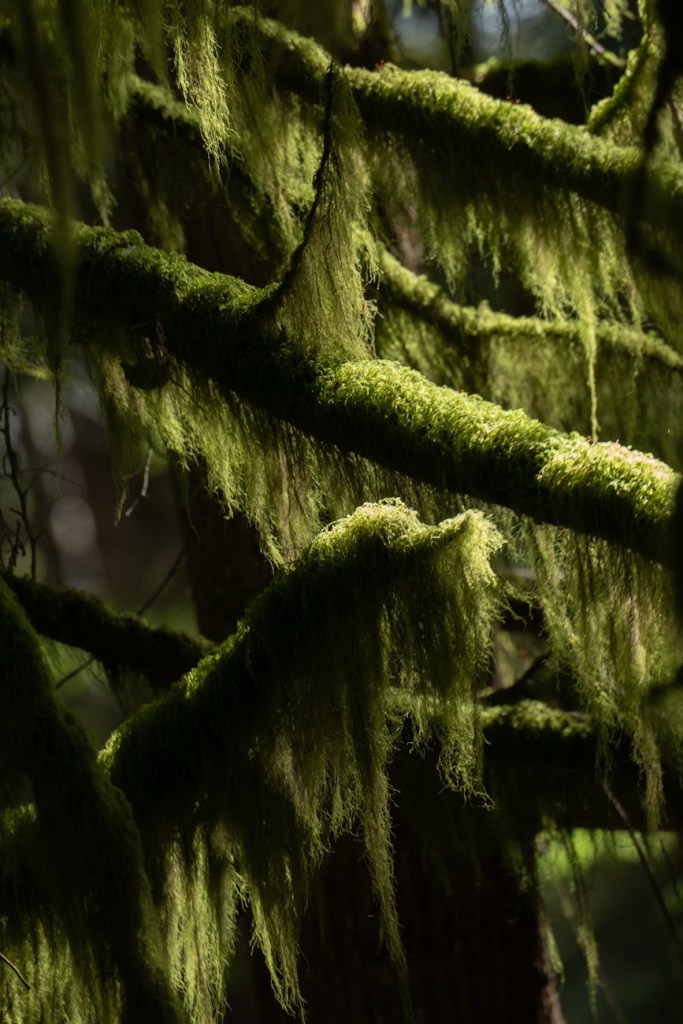
We’ve found our bedrock, learned to photosynthesize from observation, mapped our underground networks, and let our rivers move. Now we’re slowing all the way down — to the pace of something that has no interest whatsoever in your content calendar.
Moss does not care about your launch date.
It does not care about your follower count, your posting frequency, your engagement rate, or the algorithm’s current preference for short-form video. It does not have a strategy. It does not have a pivot. It does not have a three-year plan or a brand identity or a monetization model. It has one approach, applied with absolute consistency across every surface and season and century: grow. Slowly. Thoroughly. Without ceasing.
And here is what moss has accomplished with that single, unhurried approach: it has colonized every continent on Earth, including Antarctica. It has survived every mass extinction in the fossil record. It has been found growing in volcanic rock, in Arctic tundra, in the cracks of urban sidewalks, on the shaded sides of headstones in cemeteries that have been there for three hundred years. It has outlasted dinosaurs, ice ages, and every trend cycle in human history.
Moss is not slow because it lacks ambition. Moss is slow because it has found the most durable form of ambition there is.
I want to talk about what that means for us.
The Radical Act of Growing 1mm a Year
Some species of moss grow approximately one millimeter per year. One millimeter. In a culture that celebrates overnight success, viral moments, and ten-times growth, the idea of a millimeter feels almost embarrassing. Like something you’d apologize for at a dinner party. “What have I been up to? Oh, you know. Growing one millimeter.”
But let’s actually do the math.
A patch of moss that has been growing for a hundred years at one millimeter per year is ten centimeters across. That’s about the size of an orange. Which sounds modest until you consider that in those hundred years, that moss patch has survived droughts, frosts, trampling feet, and the complete transformation of its surrounding environment. It is still there. Still growing. Still slowly, inevitably covering more ground. And it has done this by being exactly what it is, at exactly the pace that is natural to it, without ever once trying to be a faster plant.
Now think about a creative project you’ve quietly tended for a long time. Not the ones you launched in a flurry of energy and abandoned when the momentum stalled — the ones you kept returning to, slowly, without fanfare, even when nothing was happening publicly. The thing you kept writing even when no one was reading. The practice you kept at even when the results were invisible.
That is your moss. And it is covering more ground than you know.
The creative culture we swim in has a deep, largely unexamined bias toward speed. We celebrate the quick pivot, the rapid iteration, the thirty-day challenge, the hundred-day project. And these things can be genuinely useful — momentum matters, and constraints produce interesting work. But they have also trained us to believe that slow equals stalled, that quiet equals irrelevant, that anything not producing visible growth right now is probably dying.
Moss would like a word.
What recalibrating to geological scale actually looks like:
• Stop measuring creative progress in days or weeks. Some work needs to be measured in seasons. Some in years. Ask yourself not “What did I produce this week?” but “What am I slowly becoming as a creative person? What ground am I quietly covering that I won’t be able to see until I look back from a distance?”
• Distinguish between speed and urgency. Some things genuinely need to move fast — a response to a timely event, a piece that’s alive in you right now and will lose its energy if you wait. But most creative work doesn’t actually have a deadline imposed by anything other than your anxiety. Learn to tell the difference.
• Find your millimeter. What’s the smallest possible consistent action toward a long work? One paragraph, three times a week. One page, every morning. Ten minutes of freewriting before the day starts. The millimeter, done reliably, covers more ground than the occasional desperate sprint.
• Let something be long. In a world of short-form everything, the deliberate, patient, long creative work is one of the most genuinely countercultural things you can make. It is also, often, the most enduring. Give yourself permission to be working on something that won’t be finished for a long time. Let that be okay. Let it be good.
• Measure by depth, not distance. A piece of moss is not impressive for how far it has spread. It is impressive for how completely it has covered its territory — how thoroughly it has integrated into its surface, how densely it has grown. Some creative projects should be wide. Some should be deep. Know which one yours is before you start judging it for not being the other.
The most durable creative legacies are almost never built fast. They’re built consistently, patiently, with the kind of quiet tenacity that doesn’t photograph well but outlasts everything that does.
Succession in Your Projects: How Ideas Pioneer, Establish, and Climax
Here’s something ecologists know that most creative people don’t apply to their own work: ecosystems don’t spring fully formed into existence. They develop through a process called ecological succession — a predictable sequence of stages, each one preparing the ground for the next, each one temporarily dominant before giving way to something richer.
It starts with pioneer species. On bare rock or disturbed soil, the first organisms to arrive are the tough ones — the ones that can survive in almost nothing, that don’t need much, that can establish a foothold where nothing else can. Lichens and mosses, often. They come first not because they’re the most complex or impressive but because they’re the most willing. They break down the rock. They collect the first thin layer of soil. They make the ground hospitable for what comes next.
Then come the early successional plants — grasses, shrubs, fast-growing opportunists that move into the soil the pioneers created. They build organic matter. They provide shade and structure. They change the microclimate in ways that allow the next wave to arrive.
And eventually, if conditions allow, you arrive at what ecologists call the climax community — the mature, complex, stable ecosystem that the whole succession was always moving toward. Old-growth forest. Prairie. Wetland. Whatever the local conditions allow as their fullest expression.
Your creative projects move through these same stages. And the failure to recognize which stage a project is in is responsible for an enormous amount of creative frustration.
The three stages, applied to your work:
Pioneer stage: The raw, necessary first attempts.
These are your first drafts, your exploratory pieces, your ‘I’m not sure what this is yet’ work. They are often rough, inconsistent, and not particularly impressive on their own. They are also absolutely essential. The pioneer project doesn’t need to be your best work. It needs to break new ground. It needs to make the soil for what comes next.
The mistake is abandoning pioneer work because it doesn’t look like climax work. Of course it doesn’t. It’s not supposed to yet. Its job is not to be the forest. Its job is to crack the rock.
Establishment stage: Growing into complexity.
This is the middle phase of a creative project or practice, and it is the most commonly misread. The work is more developed than it was, but it hasn’t reached its full expression yet. It feels like it should be further along. There are false starts. Some threads don’t work. You question whether the whole thing was a mistake.
But look at what the establishment stage is actually doing: building structure, creating depth, layering complexity. The shrubs and grasses aren’t the forest. But without them, there is no forest. Your messy, complicated, not-quite-there middle work is doing the same thing. It is building the conditions for the climax to arrive.
Climax stage: The full expression.
The work that comes together. The project that feels finished in the deepest sense — not because nothing could be changed, but because it has reached its own fullest expression. The climax piece is recognizable not just to the audience but to you. You know it when it arrives. It feels like what the whole succession was building toward.
And here’s the thing about ecological climax communities: they don’t last forever either. Fire comes. A tree falls. A new succession begins from a different starting point. The climax piece leads to the next pioneer stage. The cycle doesn’t end — it deepens. Each cycle produces richer soil than the last.
The next time you feel frustrated with work that seems slow or underdeveloped, ask yourself: what stage is this project in? And is it doing exactly what that stage requires? Sometimes the most useful thing you can do for a piece of work is recognize that it is pioneer work and stop asking it to be old-growth forest.
The Humility of Lichen: Genius as Collaboration
Lichen is not what it appears to be. For most of botanical history, it was classified as a single organism — a simple, somewhat unremarkable one. It was only when scientists looked more closely that they discovered the truth: lichen is not an organism at all. It is a relationship.
Specifically, it is a deeply intimate, mutually dependent relationship between a fungus and an algae (and sometimes a cyanobacterium as well). The fungus provides structure, physical protection, and the ability to anchor to surfaces. The algae provides photosynthesis — the ability to make food from light. Neither organism, alone, could survive in the extreme environments where lichen thrives. Bare rock faces. Arctic tundra. The surface of the moon, very nearly. But together, in this quiet and ancient collaboration, they become one of the most resilient life forms on the planet.
What looks like a single, simple thing is actually two very different organisms that have figured out how to need each other.
I find this almost unbearably useful as a creative metaphor. Because we have built an entire mythology of solitary creative genius — the lone artist, the solo visionary, the individual who produces brilliance from nothing, out of some private interior gift. And while individual creative drive is real and important, the lichen model suggests something else is also true: the work that survives the harshest conditions is almost always the work that grew from a genuine collaboration between different kinds of intelligence.
Think about the work you’ve made that you’re most proud of. How much of it was genuinely solo? How much was fed by a conversation, shaped by an editor’s question, sparked by a reader’s response, deepened by the influence of someone whose thinking lives in yours even when they’re not in the room? The lichen doesn’t announce its dual nature. From the outside, it looks like one thing. But its survival depends on the invisible partnership inside it.
The lichen qualities worth cultivating in your creative life:
• Structural humility. The fungus in lichen doesn’t try to photosynthesize. It provides what it can provide — structure, anchoring, protection — and trusts the algae to do what it cannot. Know your function. Offer it generously. Stop trying to be the whole organism.
• Metabolic generosity. The algae makes food and shares it. It doesn’t hoard its photosynthesis. The creative equivalent: when you make something, share it. When you have an insight, say it out loud. The thing you’re keeping to yourself because it might be useful later is probably most useful right now, passed to someone who can grow from it.
• Surface indifference. Lichen grows on bare rock, on glass, on the bark of dying trees, on the sides of buildings. It doesn’t wait for perfect conditions. It adapts to whatever surface it finds. Your creative work can do the same. The imperfect platform, the small audience, the unglamorous medium — these are not obstacles to growth. They are the rock face. Start there.
• Gradual, inevitable cover. Lichen doesn’t rush to cover its surface. But given enough time, it covers everything. Consistency over urgency. Persistence over intensity. The slow, steady, showing-up kind of creative life covers more ground than any sprint.
• Being unclassifiable. For most of scientific history, no one knew quite what lichen was because it didn’t fit existing categories. Your most original work probably won’t fit neatly into a genre or format either. This is not a problem. This is the lichen principle at work.
The humility of lichen is not smallness. It is the profound intelligence of knowing that what you can build together — on the hardest surfaces, in the most unforgiving conditions — is more enduring than anything you could build alone.
The Moss Mentor: This Month’s Thought-Provoking Practice
I want to offer you something different with this installment’s practice. Not a writing exercise, not a mapping tool, not a diagnostic questionnaire. Something quieter and, I think, more disorienting in the best possible way.
I want you to find yourself a Moss Mentor.
The practice:
Find a patch of moss. It doesn’t need to be beautiful or dramatic or in a particularly scenic location. The north side of a tree in a park, a shaded corner of a wall, a patch of sidewalk crack in the city, a stone in your yard. Somewhere you can return to over the coming weeks without too much trouble.
Visit it at least three times over the next month. Spend at least ten minutes each time. Bring something to write on.
Here is the crucial instruction: do not journal about what the moss does. Journal about what the moss is. Not its actions — its qualities. Its way of being in the world. This is a subtle but important distinction, and it will feel strange at first.
The difference between doing and being:
Journaling about what the moss does:
• “The moss is wet from last night’s rain.”
• “It appears slightly greener than my last visit.”
• “A leaf has fallen on part of it.”
Journaling about what the moss is:
• “The moss is patient in a way that doesn’t require an audience for its patience. It is not performing patience. It simply has no relationship with hurry.”
• “There is something communal about it — it doesn’t seem to exist in individual units. It is a we, not a collection of I’s.”
• “It is persistent without being aggressive. It doesn’t push. It occupies. There is a difference.”
• “There is a quality of completeness to it right now, in this moment, that has nothing to do with whether it will grow more later. It is finished and unfinished at the same time.”
See the difference? The second kind of journaling requires you to slow your perception down to moss-speed. To stop extracting data and start receiving presence. It is uncomfortable at first. It feels unproductive. It will feel like you are sitting outside looking at a plant for no reason, and some part of your brain will be very agitated about this.
That agitation is the point. It is the sound of your over-scheduled, output-obsessed nervous system encountering something that has absolutely no interest in its metrics. Sit with it. Let it pass. Keep looking.
The final step — embodying one quality:
After your three visits, look back at what you’ve written about your moss’s qualities. You’ll probably have a list that includes things like: patient, persistent, communal, unassuming, complete, unhurried, adaptable, present, unclassifiable, resilient, quietly inevitable.
Choose one. Just one. The quality that you notice your creative life most lacks right now. The one that feels most foreign, most necessary, most like a thing you’ve been meaning to grow toward but haven’t quite managed.
And for the rest of the month, try to embody that quality in your creative work. Not as a performance. Not as a journal prompt. As an actual orientation toward your actual work.
Some examples of what this might look like in practice:
• If you choose persistence: commit to showing up for your creative work every day this month, even if the session is only five minutes. Not because five minutes will produce much — but because the moss doesn’t stop growing on the days when conditions are imperfect. It just grows less. It still grows.
• If you choose communal: find one piece of work this month that you make in genuine collaboration with someone else. Not dividing tasks — actually making something together where both of your intelligences are visibly present in the result.
• If you choose patient: pick your most anxious project — the one you keep checking on, revising prematurely, releasing before it’s ready out of nervous energy — and deliberately leave it alone for two weeks. No touching. No checking. Let it grow at its own pace in the dark.
• If you choose present: commit to making one piece of work this month with no audience in mind. No platform, no reader, no imagined reception. Just the work itself, in this moment, for its own sake. The moss does not grow for an audience.
• If you choose unassuming: make something small deliberately. Not because you can’t make something big, but as a practice in caring equally about the small thing. A single paragraph you love. A caption that took you an hour and is twelve words long. One perfect observation. The millimeter.
At the end of the month, go back to your moss. Look at it one more time. Notice what’s different — if anything. Notice what’s exactly the same. And notice what’s different in you.
In Defense of the Unhurried
We live in a moment that treats speed as a synonym for seriousness. The faster you produce, the more committed you must be. The more you output, the more you must care. The louder and more visible your creative life, the more real it is.
Moss has been growing on this planet for at least 450 million years. It has watched every other organism hustle and compete and specialize and, in many cases, go extinct. And it has continued to do exactly one thing, at exactly its own pace, with exactly the qualities it has always had.
I am not suggesting that you aspire to be motionless or that ambition is somehow spiritually inferior to stillness. I am suggesting that there is a kind of creative life — patient, persistent, communal, unhurried, quietly inevitable — that is both more sustainable and, over time, more powerful than the sprint-and-collapse cycle that so many of us are living.
The moss doesn’t know it’s radical. It’s just being exactly what it is, at exactly its own pace, covering its ground with absolute thoroughness.
That’s the whole practice. That’s the whole invitation.
Be exactly what you are. At exactly your own pace. Cover your ground.

 Platnumkitty
Leave a comment