Part 6 of The Geology of Ideas series.
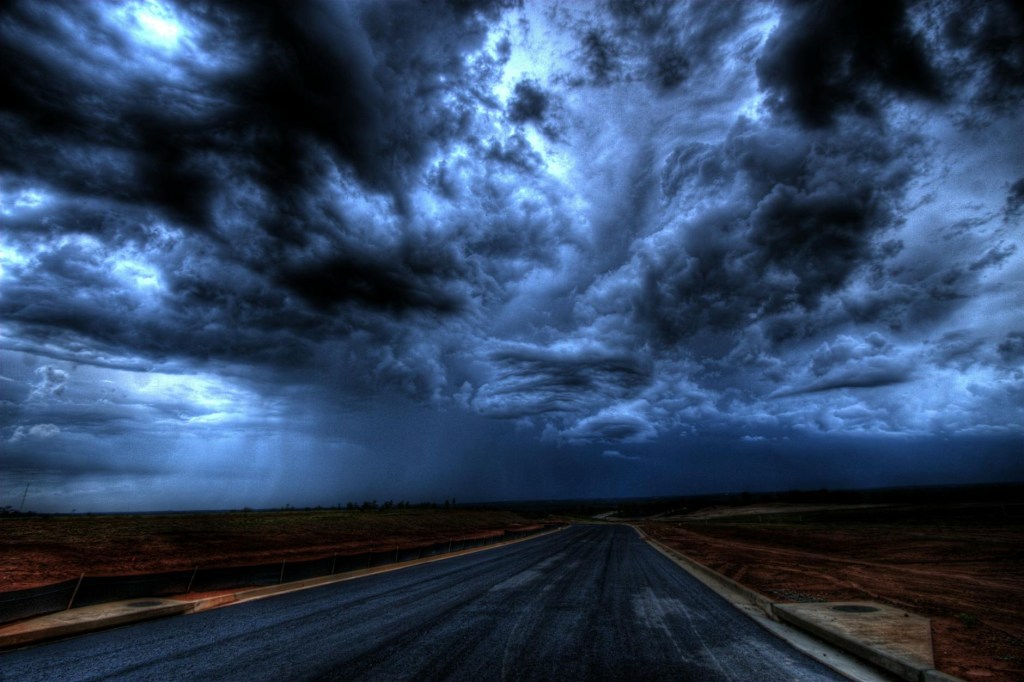
We’ve grown with the moss, let the rivers move, mapped the underground networks, and learned to photosynthesize from stillness. Now the weather turns. This one is for the storms.
I wrote one of the most honest things I’ve ever written on the worst day of a particular year.
I wasn’t planning to write. I wasn’t in the mood, by any conventional understanding of what mood means. I was furious and sad and the kind of tired that lives behind your eyes, and I sat down at my desk not because I had something to say but because I had nowhere else to put what was happening inside me. And what came out was not polished or structured or particularly careful. It was pressurized. It was the creative equivalent of a weather system that had been building for days finally making contact with the ground.
I almost didn’t keep it. It felt too raw, too exposed, too much like something you write and then delete before anyone can see it. But I kept it. And months later, when I finally shaped it into something shareable, the people who read it told me it was the truest thing I’d made.
The storm made it. Not despite its intensity — because of it.
This is what I want to talk about today: the creative power of emotional turbulence. Not how to manage it, not how to soothe it back into something comfortable, but how to use it — how to let the storm do what storms actually do, which is generate enormous amounts of energy and leave everything changed in their wake.
The Barometric Pressure of Emotion: Frustration, Grief, and Anger as Creative Fuel
A storm doesn’t arrive from nowhere. It builds from a difference in pressure — a cold front meeting warm air, a system of low pressure pulling energy from the atmosphere around it, building charge and density and momentum until conditions reach a tipping point and the weather breaks. The storm is not a malfunction in the atmosphere. It is the atmosphere doing exactly what it does when certain forces meet.
Emotional turbulence works the same way. Frustration is a pressure differential — the gap between what you expect and what is. Grief is a system of low pressure where something that used to fill space has been suddenly removed and the surrounding air is rushing in to fill the void. Anger is charge building between systems that are in conflict, looking for the path to ground.
None of these are malfunctions. They are your interior atmosphere doing exactly what it does when certain forces meet.
And here’s the thing about pressure systems: they contain extraordinary energy. The question is never whether a storm has power — it always does. The question is whether that power gets released destructively, dissipated uselessly, or channeled into something that transforms the landscape.
We are taught, with enormous cultural consistency, to manage our emotional storms. To regulate, to process, to soothe, to reach equilibrium as quickly as possible. And emotional regulation is genuinely important — I’m not arguing against therapy or breathing exercises or calling a friend. But there is a specific window, right in the middle of the storm’s intensity, before the pressure dissipates back into calm, when the creative energy available to you is unlike anything you can manufacture from a regulated, comfortable state.
Some of the most honest art ever made was made in that window. Not after the emotion was processed and understood and safely in the past — while it was still happening. While the pressure was still building. While the charge was still live.
Understanding your personal pressure systems:
Frustration as generative pressure.
Frustration is one of the most consistently underrated creative fuels. It arrives when something should be different than it is — when a system is broken, when an injustice is casual, when something beautiful is being ignored or something mediocre is being celebrated. That gap between what is and what should be? That’s pressure. That’s a weather system. And the work that comes out of it has an edge that comfortable, satisfied work almost never achieves.
When you feel frustrated — with your industry, with your own work, with the world at large — before you reach for the thing that will make it go away, ask: what is this frustration trying to say? What does it know that I haven’t articulated yet? What piece of work is this pressure building toward?
Grief as low-pressure system.
Grief is slower than frustration or anger. It doesn’t arrive with thunder — it arrives like a change in the air pressure you feel in your chest before rain comes. It is heavy. It is disorienting. And it tends to dissolve the filters between what you actually feel and what you allow yourself to say.
This is why some of the most piercingly true creative work emerges from grief. Not because suffering is ennobling — it isn’t, inherently — but because grief removes the social maintenance layer. The part of you that manages impressions, that keeps things appropriate, that worries about how it lands. Grief doesn’t have the energy for that. What’s left is the bare thing. And the bare thing, expressed honestly, is what connects.
I’ve written about people I’ve lost. About places I’ve left and the specific texture of missing them — the way New Orleans stays in you, the way Greece gives you a homesickness for somewhere that was never exactly home. Grief for a place is a particular kind of low-pressure system, and I have found that the work I make inside it is both harder to write and more worth writing than almost anything I produce in calmer conditions.
Anger as electrical charge.
Anger is the most misunderstood creative fuel because we are most afraid of it. We have been taught, many of us and particularly women, that anger is destructive, inappropriate, something to be controlled and minimized and apologized for. And so it gets suppressed, and the charge builds without release, and eventually it comes out sideways in ways that are actually less useful than if it had been channeled directly.
Anger, given a creative channel, is clarifying in a way almost nothing else is. It knows exactly what it’s about. It doesn’t hedge. It doesn’t soften. It goes straight to the thing and names it without apology. The best essays I’ve ever read were written from a place of controlled, directed anger — someone who cared enough about something to be furious about its opposite. Anger is conviction with heat. It is some of the most powerful raw material you will ever have access to.
The key with all three of these pressure systems is not to wait until they’ve passed to make something. By the time the storm is over, the pressure is gone. The energy that made the work possible has dissipated back into the atmosphere. You can revisit it intellectually, but the live charge — the thing that makes the work feel true rather than reconstructed — that lives only in the storm itself.
Clearing the Air: The Creative Clarity That Follows an Emotional Downpour
Anyone who has ever stood outside after a thunderstorm knows the particular quality of the air that follows. It is washed. It is sharp. There is a clarity to it — a crispness to the light, a freshness to the smell, a sense that something has been released and the atmosphere is starting again from a cleaner point.
What you’re experiencing is real and measurable: rain washes particulate matter from the air. Lightning produces ozone. The pressure differential that drove the storm has equalized. The atmosphere after a storm is literally different from the atmosphere before it — cleaner, clearer, reorganized.
Your creative mind experiences the same reset after an emotional downpour.
The post-storm state is one of the most creatively valuable and least discussed states in a creative person’s life. After an emotional release — a cry that was actually a cry, a conversation that finally named the thing, a creative session in the storm that got it out of you and onto the page — there is a window of unusual clarity. The mental static that emotional turbulence generates has been discharged. What’s left is quiet, open, and surprisingly generative.
This is the time for a different kind of creative work. Not the raw, pressurized output of the storm itself, but the more structural work that benefits from the cleared air afterward: editing what the storm produced, finding the shape of something that arrived in fragments, seeing clearly what the turbulence was actually about now that it has passed.
How to use the post-storm window well:
• Don’t rush to normalize. The clarity after an emotional downpour is temporary — the ordinary static of daily life will return soon enough. Before it does, sit in the cleared air. Notice what looks different from here. Notice what you can see now that the pressure was obscuring before.
• Read what you wrote in the storm. Often what emerges in the raw, pressurized state of emotional turbulence contains insights you couldn’t have accessed any other way. Read it with the curiosity of someone finding a message in a bottle, not the judgment of an editor. What did the storm know?
• Ask the post-storm question. What is clearer to me now than it was before this? What did this emotion know that I didn’t? What is it telling me about what I actually value, actually fear, actually want my work to do in the world?
• Shape, don’t sanitize. There is a difference between refining raw storm-material into something shareable and sanding off everything that made it true. The post-storm clarity is for finding the structure, not for eliminating the feeling. Keep the charge. Remove only what’s in the way of it.
• Notice what the storm loosened. An emotional release often shakes loose things that weren’t directly related to what caused it — old ideas that have been stuck, decisions that have been pending, creative directions that couldn’t find their way through the static. In the cleared air, look around. What else has come loose? What’s available now that wasn’t before?
The storm and the clarity that follows it are a complete creative cycle. You need both. The storm generates the material; the cleared air reveals what it means. Neither state is better. Both are necessary. And learning to move deliberately between them — to use the storm while it’s here and the calm while it lasts — is one of the most sophisticated creative skills you can develop.
Lightning-Strike Insights: Preparing the Ground for Epiphanies
Lightning doesn’t strike randomly. This is one of those facts that sounds like a figure of speech until you learn the actual physics, and then it becomes one of the most useful things you know.
A lightning bolt is looking for the path of least resistance between a charged cloud and the ground. It does not choose the tallest object arbitrarily. It chooses the object that has already begun to reach toward it — the thing that has built enough charge on its own surface to send an invisible leader channel upward, meeting the stroke coming down from the cloud. The lightning bolt completes a connection that was already halfway formed. The ground has to be ready to receive it.
Epiphanies work exactly like this. And this is the part nobody tells you about creative insight: the bolt doesn’t strike unprepared ground. It strikes the person who has been doing the quiet, invisible work of building charge — reading, thinking, living, accumulating questions without forcing answers. The ‘sudden’ insight is sudden only in its final moment of connection. Everything leading up to it was preparation.
This is why epiphanies happen in the shower, on long drives, in the middle of the night. Not because those are magical locations — because those are the moments when the analytical mind steps back and the charge you’ve been building gets to make its connection without interference. The bolt was always going to strike. You just had to stop blocking the path.
How to prepare the ground so lightning can land:
• Build charge deliberately. The lightning-strike insight doesn’t arrive in a vacuum. It arrives after you’ve been genuinely grappling with a question — not just thinking about it casually, but carrying it with real intensity, turning it over, approaching it from different directions, letting it live in you. Give your open questions weight. Carry them intentionally.
• Create conditions for the connection. The shower works because it’s a transitional space where the analytical mind relaxes. Find your equivalent: the long walk, the drive, the period between waking and fully conscious. Protect those spaces. They are not unproductive. They are where your charge meets the cloud.
• Write the question before you sleep. The period just before sleep and the period just after waking are two of the richest neurological states for creative insight. Before you sleep, write down the question you’re working on — specifically, precisely, as a real question. Your brain will work on it while you sleep. The morning’s first few minutes, before the day’s noise arrives, are often when the bolt lands.
• Notice the pre-lightning feeling. Many creative people describe a particular sensation before a major insight arrives — a restlessness, a kind of low-level agitation, a sense that something is about to resolve. Learn to recognize this in yourself. When you feel it, don’t fill it with distraction. The charge is building. The connection is close.
• Capture immediately. A lightning bolt lasts a fraction of a second. The insight that arrives fully formed in a moment of clarity can evaporate just as fast if you don’t capture it. Keep something to write on within reach during your high-lightning times — the walks, the transitions, the mornings. The bolt doesn’t wait for a convenient moment to record it.
The people who seem to have the most creative insights are not simply luckier or more gifted. They have, usually without consciously knowing it, learned to build charge — to carry their questions with real weight, to create conditions for connection, and to capture the bolt when it comes. Luck in creativity is mostly preparation meeting the right atmospheric conditions. You can influence both.
The Storm Prompt: This Installment’s Raw Creative Challenge
This prompt is different from the others in this series. The sit spot gave you a specific time and place. The mycelial map gave you a structure. Even the moss mentor practice had a defined shape. This one doesn’t.
This one requires waiting. And then it requires courage.
The next time you feel a storm of emotion — real frustration, actual grief, live anger, the kind of feeling that you usually immediately try to manage down or push away or talk yourself out of — don’t calm it.
Channel it. Write with it, draw with it, move with it — whatever creative form is most instinctive to you in that moment. Don’t shape it. Don’t edit it. Don’t aim it at a platform or an audience or a outcome. Let the raw energy of the storm move through the work without you managing where it goes. See what forms in the aftermath.
A few things to know before you try this:
It won’t look like your best work. That’s the point.
Storm-work is raw material, not finished product. The sentences might be broken. The logic might be circular. There might be more feeling than form. This is correct. You are not making a post. You are making the sediment that a future post will be built from. The quality of the storm-output is not the point. The honesty of it is.
You don’t have to share it.
The storm-channeling practice is not about producing content for public consumption. Some of it you’ll eventually shape into something worth sharing. Some of it is purely private — a release valve, a pressure equalization, a thing that had to exist so you could keep existing. Both outcomes are valuable. You do not owe anyone your storms. But you owe yourself the practice of not suppressing them.
The form can be anything.
Write. Draw. Move. Photograph. Make a voice memo that’s just you talking unfiltered into your phone for eight minutes. Paint something ugly and true. Rearrange objects until the arrangement says something you can’t say in words. The creative medium in a storm is less important than the willingness to let the energy move through something rather than just through you. Give it a channel. Any channel.
Examine the aftermath.
After the storm has passed and the air has cleared, come back to what you made. Read it, or look at it, or listen to it, with the question: what does this know that I didn’t consciously know I knew? What did the storm surface? Where is the live current in this? What one line, or image, or moment feels more true than anything I’ve made from a calmer state recently?
That live current — that’s the lightning. That’s what you were building charge for. That’s the thing worth keeping, shaping, eventually sharing.
Some questions to carry into your next storm:
• What is this emotion trying to say that I haven’t let myself say yet in my work?
• If this feeling were a piece of writing, what would its opening line be?
• What is the thing I’m most afraid to be honest about right now? Is this storm related to that fear?
• What would I make if I knew no one would ever see it — and I had to use exactly this energy, right now?
• What does this storm know about what I actually care about?
You don’t have to answer these in the storm. In the storm, you just create. The questions are for the cleared air afterward — for finding the shape of what the storm left behind.
What the Storm Is Really For
There is a version of creative life that only happens in good conditions. When you’re rested, inspired, not too sad, not too frustrated, with enough time and a clean desk and the right music and the particular quality of afternoon light that makes things feel possible. And that version of creative life produces real work. I’m not dismissing it.
But there is another version — the one that happens in the storm, or in the cleared air that follows it, or in the charged atmospheric tension right before it breaks — that produces the work you will still be proud of in ten years. The work that people return to. The work that makes someone feel, when they read it, that they are finally not alone in whatever they’ve been carrying.
The storm is not the enemy of your creative life. It is one of its most powerful engines. The frustration, the grief, the anger, the restlessness, the ache of something unresolved — these are not interruptions to the work. They are the pressure systems that drive the most necessary work. The kind that couldn’t exist without exactly that kind of weather.
The next time the barometric pressure drops and you feel it in your chest before you see it in the sky — don’t reach for the thing that makes it stop.
Reach for something to make.


 Platnumkitty
Leave a comment